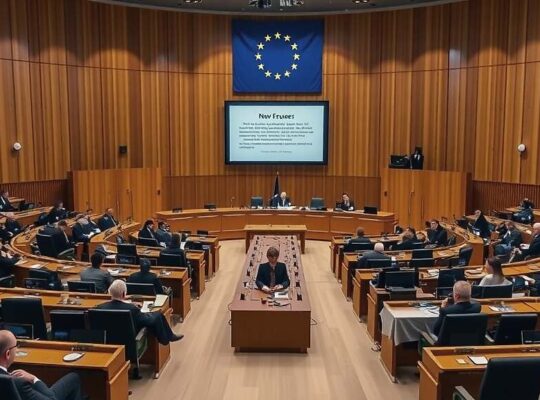
To counter the threat to parliament from cyberattacks, Bundestag President Julia Klöckner (CDU) has announced extensive renovations of the Reichstag. She told the “Rheinische Post” that around 3 800 km of copper cables, 300 km of fibre‑optic cables, 300 data‑distribution units and hundreds of servers will have to be replaced. The leader likened the copper length to the total perimeter of Germany’s borders – in principle it could encircle the country – and expects the digital strategy to be adopted quickly so that work can begin before the summer.
Klöckner framed the plan as a “3‑S strategy”: “Sicherheit” (security), “Souveränität” (sovereignty) and “Service‑orientierung” (service orientation). The goal is an IT environment that is resilient against cyberattacks and system failures, and a reduction in dependence on single suppliers and infrastructures. At the same time users should retain the freedom to choose the systems they use. “The Bundestag must keep control over its data and how it is used” she added, “so future digital access will be granted more restrictively”.
She also urged progress on the long‑debated parliamentary police law. “I am convinced that the parties will reach an agreement this year. Anything else would not make sense” she said. The Bundestag sees about two million visitors annually and needs to know whether any of them are classified as potential threats or have shown constitution‑endangering behavior. Legal backing is required for exchanging such information with intelligence services.