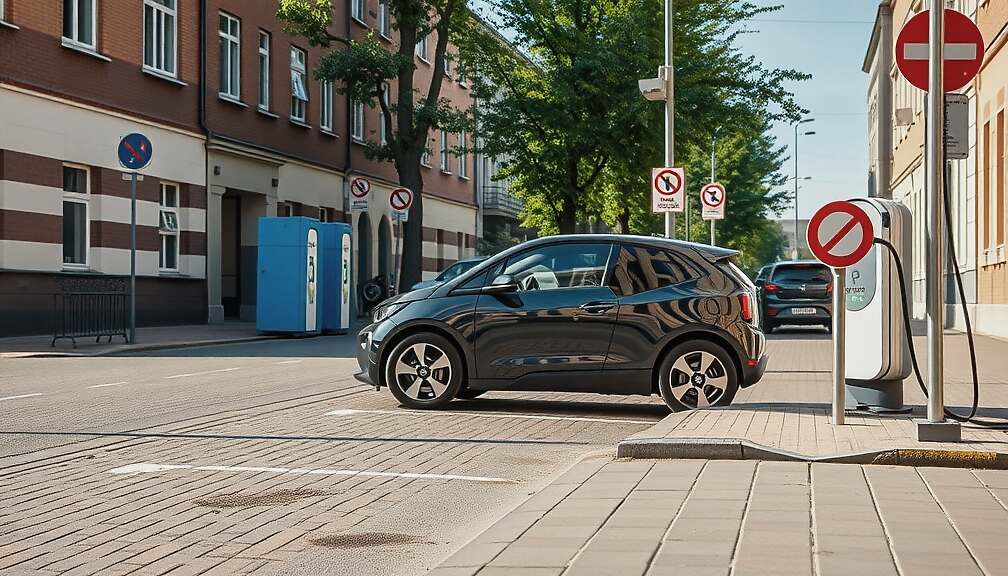
According to a response from the Federal Government to a query by the Left parliamentary group, the provision of publicly accessible charging stations for electric vehicles remains significantly underdeveloped in Germany.
Current data (as of May 25, 2026) indicates that 4,548 out of 10,775 municipalities-or 42%-do not have any publicly available charging infrastructure. The response also noted that such infrastructure is especially crucial for urban areas and communes that possess the characteristics of a city region where multi-party housing without private parking spaces is prevalent. However, when considering all German municipalities with a population exceeding 5,000, 99% are equipped with at least one public charging point.
The availability of this infrastructure varies widely across the 16 federal states. Specifically, Berlin, Hamburg, Bremen, North Rhine-Westphalia, and Saarland have achieved 100% coverage of their municipalities with public charging infrastructure. Conversely, several states lag considerably, including Thuringia (35%), Mecklenburg-Vorpommern (32%), Rhineland-Palatinate (28%), and Schleswig-Holstein (41%).
Dietmar Bartsch, a member of the Left party in the Bundestag, strongly criticized this deficit. He argued that while the purchase of electric vehicles is being subsidized with vast sums, the public charging infrastructure is falling dangerously behind. Bartsch suggested that instead of subsidizing electric luxury cars, the state’s investment focus should be placed on building out the necessary infrastructure. He stressed that only by ensuring infrastructure for everyone, even those without private charging options, can the transition to e-mobility succeed.
Bartsch particularly highlighted deficiencies in East Germany, noting a severe disparity: every second municipality in the East lacks public charging, compared to approximately every fourth municipality in the West. In Mecklenburg-Vorpommern, he pointed out that two-thirds of the municipalities are affected.
The Federal Government recently announced subsidies for private households earning up to €80,000 annually, offering a grant between €1,500 and €6,000 when purchasing EVs, a measure retroactive to January 1. Increased demand is also being driven by rising oil prices, following the conflict in Iran. Nevertheless, the widespread lack of charging infrastructure continues to be cited as the major weakness hindering the transition away from combustion engine vehicles.