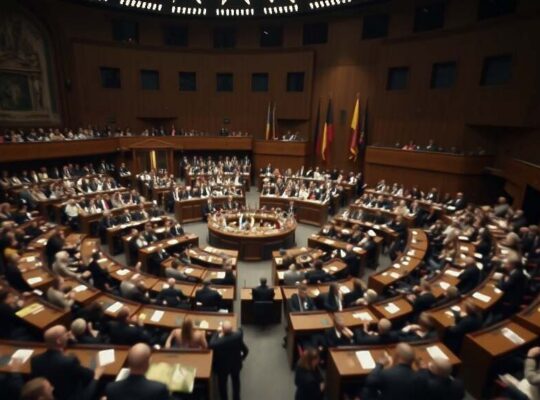
Internal divisions within the Christian Democratic Union (CDU) and its Bavarian sister party, the CSU, are intensifying over the recently agreed pension reform package. While a substantial majority within the CDU/CSU parliamentary group approved the legislation during Tuesday’s session, a significant number – reportedly around a dozen – voted against it in a procedural vote, highlighting the precariousness of the coalition’s position.
The dissenting voices are believed to originate from a faction known as the “Young Group” closely associated with the Junge Union, the party’s youth wing. Led by figures like Johannes Winkel, these parliamentarians have publicly voiced their concerns that the pension deal places an unfair burden on future generations. Their opposition stems from a belief that the reforms fail to adequately address long-term sustainability and exacerbate intergenerational inequity.
Fraktionschef Jens Spahn (CDU) has attempted to assert party discipline, indicating his expectation that even dissenting members will ultimately support the package in Friday’s Bundestag vote. He suggested that those planning to deviate from the party line should proactively engage in discussions before the vote, implicitly threatening consequences for those who refuse.
Parliamentary rules dictate that any deviation requires notification to the party leadership by the day before the vote, meaning Thursday in this case. However, party officials are now demanding notifications as early as Wednesday noon, underscoring the urgency with which the leadership seeks to manage the situation and enforce compliance.
Speculation of a postponement of the vote or linking it to a confidence vote appears unfounded, according to sources within the parliamentary group.
The coalition government, comprised of the CDU/CSU and the SPD, holds a narrow majority in the Bundestag, a mere twelve votes beyond the threshold required for a “chancellor’s majority”. Therefore, the refusal of a dozen CDU/CSU parliamentarians could jeopardize the coalition’s ability to pass critical legislation, exposing vulnerabilities in the government’s stability and forcing a reassessment of the strategy involving the contentious pension deal. The episode underscores a deeper ideological rift within the CDU/CSU and raises questions about the ability of the coalition to maintain cohesion amidst growing internal pressure and escalating political risks.