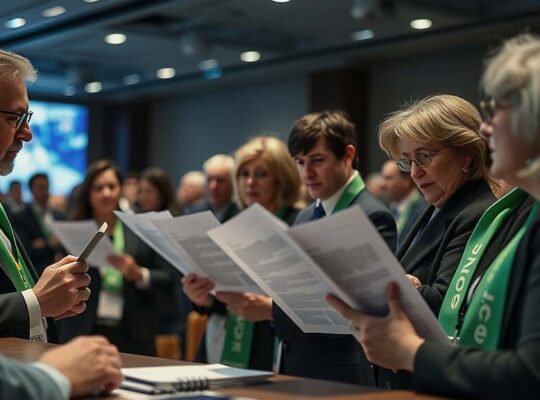
The “Alliance Sahra Wagenknecht” (BSW) is undergoing a significant rebranding, officially transitioning to “Alliance for Social Justice and Economic Soundness” – a move ratified by a substantial majority at the party’s convention in Magdeburg this Saturday. The formal change will take effect on October 2026, following a prior deliberation period that generated over 3,000 name suggestions. According to outgoing General Secretary Christian Leye, the new moniker aims for enduring relevance, designed to “function even in 15 years.
However, the rebranding process has not been without internal dissent. Several delegates voiced criticism, one derisively labeling the new name a “word chain monster” and proposing “Citizens Shape Change” as an alternative. This proposal, along with another favoring “Alliance for a Social Path” failed to gain traction.
Beyond the superficial change in name, the convention marks a period of personnel shifts, signaling a distancing from the prominent figure of Sahra Wagenknecht. A new party executive board will be elected, with Fabio De Masi and Amira Mohamed Ali put forward as candidates. Former Bundesliga club manager Oliver Ruhnert is vying for the position of General Secretary.
While relinquishing her role as party leader, Wagenknecht will chair a newly established “Fundamental Values Commission” within the BSW. This development, also approved by a significant margin, accompanies a liberalization of the party’s membership policy, streamlining the process to automatically grant membership two months after application, barring exceptional circumstances.
In a farewell address laden with political urgency, Wagenknecht delivered a stark warning about Germany’s economic trajectory. She cautioned that the nation faces economic decline and a potential loss of industrial strength and prosperity. Drawing a provocative parallel to the late stages of the German Democratic Republic (GDR), Wagenknecht criticized contemporary economic discourse as characterized by “whitewashing” and “glossy optimism” that obscures a more troubling reality. The speech underscored a desire to maintain a distinct political voice, even as she pivots to a less central role and could signal a future chapter in her political ambitions, potentially fracturing the party’s direction.