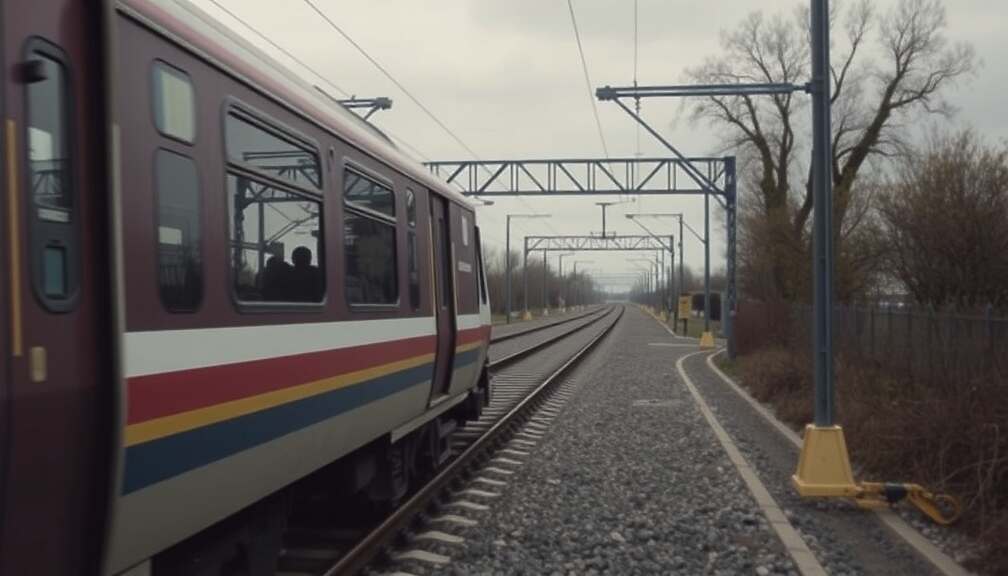
The German Federal Ministry of Transport continues to delay providing a timeline for the full operational implementation of the European Train Control System (ETCS) on the Riedbahn railway line, a year after its extensive refurbishment. A parliamentary inquiry reveals that the northern section remains without ETCS functionality due to an ongoing and unresolved safety verification process for the system’s software. Acceptance trials, dubbed “Abnahmefahrten” are currently scheduled for mid-February.
The delay, detailed in a response to Green Party parliamentarian Matthias Gastel and reported by “Der Tagesspiegel”, highlights a growing concern about the efficacy of the German government’s strategy for railway modernization. Trains currently traversing the Riedbahn without ETCS are restricted to a speed of 160 kilometers per hour, losing approximately two minutes per journey compared to their potential maximum speed of 200 km/h, relying on the alternative PZB signaling system. This situation has resulted in journey times slower than those prior to the costly and disruptive reconstruction.
Matthias Gastel, the Green Party’s spokesperson for rail policy, is increasingly questioning the value of the “generalsanierung” approach – a strategy involving prolonged track closures and simultaneous renewal of multiple infrastructure components. He argues that the promises inherent in these large-scale overhauls are repeatedly not being met. The prolonged inability of Deutsche Bahn and its industrial partners to fully implement ETCS on the Riedbahn raises serious questions about the viability of future generalsanierungen and casts a negative light on the government’s broader rail improvement agenda.
Gastel emphasized that the strategy’s future depends on a dramatic reduction in operational failures and the complete realization of necessary upgrades, with ETCS being paramount. He demands a concrete and guaranteed schedule for the Riedbahn’s ETCS deployment, insisting that operation must proceed without further track closures. The ongoing impasse underscores the risk that these substantial infrastructure investments are ultimately failing to deliver the expected performance gains for passengers and the national railway network. The case of the Riedbahn is now being scrutinized as a critical test case for the future of Germany’s rail modernization plans.