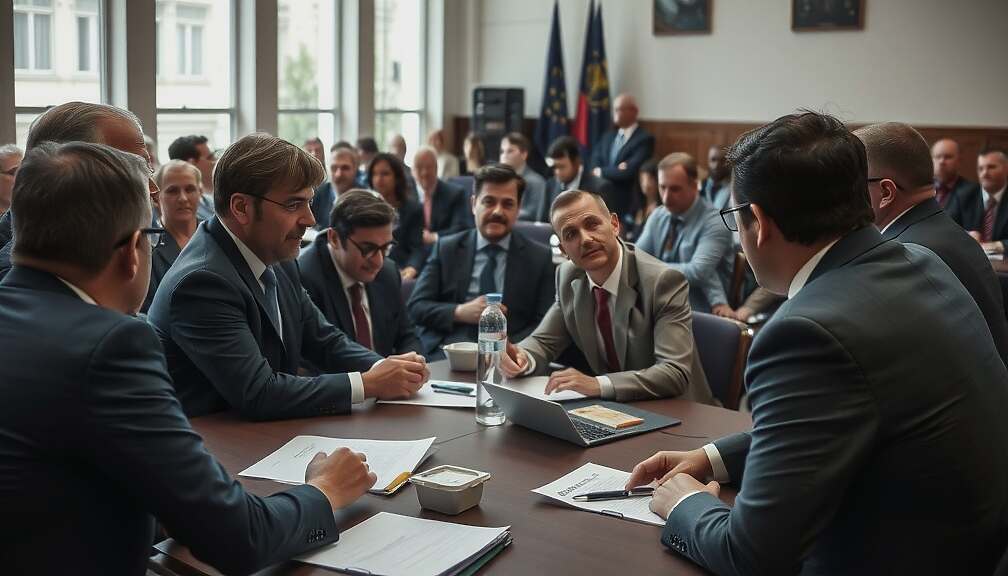
Internal divisions are erupting within the European Parliament over a planned delegation to Ukraine, highlighting deeper ideological tensions and raising critical questions about security protocols and political maneuvering. According to reports obtained by “Der Spiegel”, a dispute has arisen concerning the inclusion of a member from the European Solidarity Group (ESG), a far-right faction that includes the Alternative for Germany (AfD), on a visit organized by the Defense Committee.
Liberal and Social Democrat circles accuse the center-right European People’s Party (EPP), a coalition that includes the Christian Democratic Union (CDU) and Christian Social Union (CSU), of attempting to force the inclusion of the ESG representative, despite significant concerns. The controversy intensified after Ukraine itself warned of potential security risks associated with the proposed travel of ESG member Hans Neuhoff, leading to the removal of several sensitive meetings from the planned itinerary.
Marie-Agnes Strack-Zimmermann, Chair of the EU Defense Committee (and a representative of the FDP – Free Democratic Party), subsequently attempted to reorganize the trip, excluding ESG members entirely. However, the issue resurfaced during a meeting of faction secretaries last week, where Liberals, Greens and Social Democrats voiced support for the revised plan. A coalition of extreme-right factions and the EPP, however, opposed it. Unexpected resistance from EPP staff this week further complicated the matter.
While the EPP publicly claims it has no objections to excluding an ESG member from the delegation, they assert that procedural rules were not followed in the initial planning process. They have also suggested that if an ESG representative must travel, it need not be Neuhoff specifically. Conversely, Liberals argue that all right-nationalist members of the ESG pose a genuine security risk to Ukraine and dismiss the EPP’s arguments as disingenuous maneuvers.
The escalating conflict underscores a broader struggle for influence within the European Parliament, with security considerations seemingly entangled with factional politics and a potential willingness to leverage concerns to advance partisan agendas. This episode also exposes the delicate balance the EU must strike when engaging with Ukraine while navigating the complex dynamics of its own internal political landscape.