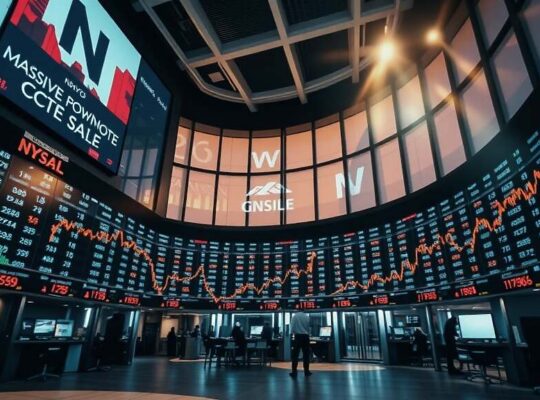
US stock markets concluded trading before the Christmas holiday with a surge, propelling the Dow Jones Industrial Average to 48,731 points, a 0.6% increase from the previous day’s close. The Nasdaq 100, housing major technology firms, climbed to 25,656 points, marking a 0.3% rise, while the broader S&P 500 surpassed an unprecedented level, closing at 6,932.05 points, also up 0.3%. Trading volumes, as typically observed during the holiday season, were significantly reduced compared to regular market days.
The Euro experienced a slight depreciation against the US dollar, exchanging at $1.1775, translating to €0.8493 per dollar. This movement, while seemingly modest, underscores the ongoing volatility in currency markets, potentially reflecting anxieties regarding diverging economic trajectories and the impact of differing monetary policies across the Atlantic. Analysts suggest the Euro’s weakness could be influenced by cautious optimism regarding US economic resilience, contrasting with lingering concerns about European growth prospects.
Gold, which has demonstrated a remarkable upward trend for months, saw a minor retraction. The price settled at $4,478 per fine ounce (-0.2%), equivalent to €122.27 per gram. This slight downturn, despite the recent rally, might be attributed to the lower trading volumes and a general risk-off sentiment observed during the holiday period, combined with the broader strengthening of the US dollar. The sustained high price of gold, however, continues to signal persistent inflation concerns and a flight to safe-haven assets as geopolitical instability remains a prominent factor.
The price of Brent crude oil also declined, reaching $62.23 per barrel, a decrease of 15 cents or 0.2% compared to the previous trading day’s close. This modest drop, while seemingly insignificant in isolation, may be a harbinger of wider shifts in energy markets, potentially influenced by fluctuating demand and the ongoing geopolitical uncertainties impacting global supply chains. Further analysis is needed to determine whether this is a temporary correction or the start of a more substantial trend. The muted reaction, however, highlights the complex interplay of factors currently shaping oil prices, beyond simple supply and demand dynamics.