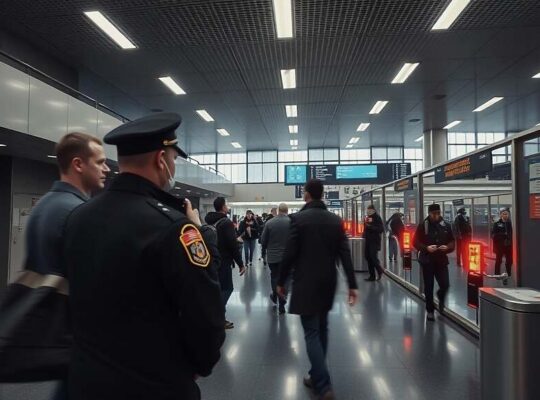
The German Justice Minister, Stefanie Hubig of the SPD, is spearheading a significant legislative overhaul designed to severely escalate penalties for attacks on law enforcement, emergency responders and other public servants. The proposed measures, detailed in a draft bill revealed by the Funke-Mediengruppe newspapers, represent a marked shift in the government’s response to what Hubig describes as a disturbing escalation in violence directed at those upholding public order and providing essential services.
A central element of the plan involves increasing the minimum prison sentence for physical assaults on police officers, firefighters, paramedics, court officials and increasingly, medical professionals. The current minimum of three months imprisonment will be raised to a mandatory six months. Crucially, the legislation also targets those who lure emergency personnel into ambushes, proposing a minimum sentence of one year, up from the previous six months. This highlights a growing concern over increasingly deliberate and targeted attacks against responders.
Hubig emphasized the severity of the situation, directly referencing the unacceptable levels of violence observed during recent New Year’s Eve celebrations. She argues that a robust response from the rule of law is imperative to counteract what she terms a “moral decline” and prevent further escalation. The heightened protection extended to medical staff, bringing their sentencing parity with those attacking law enforcement, is particularly noteworthy, addressing concerns about the safety of healthcare workers, especially given the pressures of the healthcare system.
Beyond safeguarding frontline workers, the legislation extends its protective umbrella to volunteers, local politicians and Members of the European Parliament, facing a growing tide of threats and intimidation. A new provision allows judges to impose harsher penalties when a crime demonstrably aims to disrupt or impair activities serving the public good – a subtle but important acknowledgement of the chilling effect such threats have on civic participation and democratic processes. This aspect is likely to fuel debate about the scope of state intervention in protecting political figures.
Perhaps the most politically charged aspect of the proposed reforms is the significant toughening of measures against hate speech and incitement to violence. The potential prison sentence for such offenses will increase from three to five years. Furthermore, individuals convicted of hate speech and sentenced to imprisonment of at least six months will be barred from holding public office or running for election for a period of five years, effectively disenfranchising convicted individuals – a measure that is sure to attract constitutional challenges and accusations of political overreach. Critics argue this expands the reach of the state into free speech protections, while proponents insist it’s a necessary step to protect vulnerable communities and safeguard democratic values.
The draft bill is expected to spark intense debate within the Bundestag and across German society, with questions arising about the balance between public safety, individual rights and the potential for unintended consequences related to over-criminalization and restrictions on civil liberties.