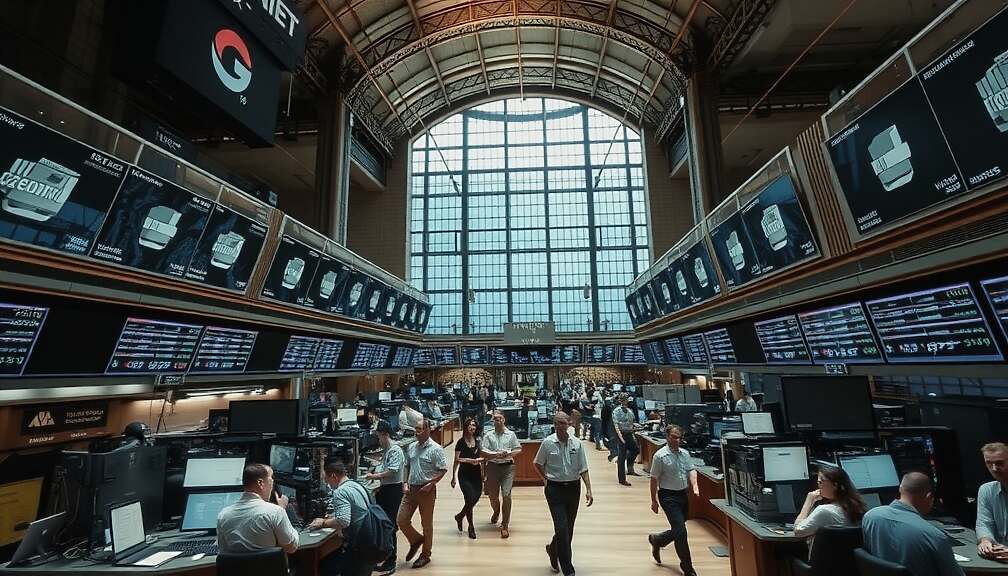
The German stock market opened marginally unchanged on Tuesday, the final trading day of 2025, signaling a muted end to a year characterized by stark contrasts. The benchmark DAX index stood at approximately 24,345 points around 9:30 am, a slight dip from the previous day’s closing level. While Rheinmetall, Commerzbank and Continental led the gains, Siemens Energy, Bayer and BMW lagged at the bottom of the list.
Monday will see a shortened trading session to conclude the year, with little expectation of significant activity or portfolio adjustments. The 30th of December consistently registers as one of the lowest-volume trading days of the year.
Despite the overall narrative of a “generally excellent” year for the stock market, as described by Thomas Altmann of QC Partners, a deeper analysis reveals a more nuanced reality. Altmann points out that the DAX’s strong performance was largely concentrated in the first six months, with the latter half of the year exhibiting a period of stagnation. “Of its 34 all-time highs recorded this year, 31 were achieved in the first half, a stark contrast to the mere three reached in the second” he noted, highlighting a potential undercurrent of waning investor confidence in the latter portion of the year.
This phenomenon warrants closer examination, particularly in the context of evolving geopolitical uncertainties and increasingly cautious economic forecasts across the Eurozone. While the initial rally may have been spurred by post-pandemic recovery optimism, the subsequent plateau suggests that these gains may be facing headwinds. The shift in investor sentiment, evident in the DAX’s performance, could reflect concerns regarding persistent inflation, rising interest rates and the impact of ongoing global conflicts.
The Euro slightly strengthened in early trading, fetching $1.1770, with a dollar costing €0.8496. A modest increase in crude oil prices, with Brent North Sea crude reaching $61.97 a barrel, adds another layer to the complex economic landscape. This marginal increase, though seemingly insignificant, could contribute to inflationary pressures and potentially exacerbate the challenges facing the German economy in the new year.
Analysts are now keenly observing whether the weaker second-half performance is a temporary correction or a harbinger of a more substantial slowdown in the coming months, a crucial factor for policymakers and investors as they navigate an increasingly uncertain future.