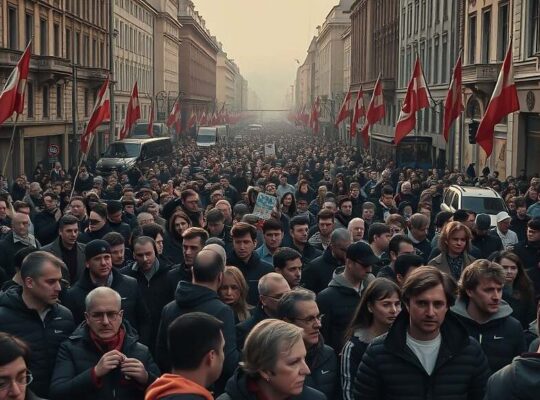
The European Union is prepared to escalate sanctions against the Iranian regime in response to escalating tensions and the brutal suppression of widespread protests, according to EU High Representative for Foreign Affairs and Security Policy, Kaja Kallas. Addressing concerns in an interview, Kallas emphasized the EU’s existing comprehensive sanctions targeting individuals responsible for human rights abuses, advancements in the nuclear program and Tehran’s support for Russia’s war in Ukraine. She signaled a willingness to propose further measures as a direct consequence of the security forces’ violent response to demonstrators.
Kallas highlighted the magnitude of the ongoing protests within Iran, describing them as the largest in years and representing a struggle for self-determination by Iranian citizens facing significant risk. She condemned the regime’s history of suppressing dissent and underscored the “unacceptable” use of force against peaceful protesters.
Beyond Iran, Kallas drew a surprising parallel between geopolitical tensions and the Arctic region, referencing former U.S. President Trump’s past claims regarding Greenland. She argued that, given potential security concerns, NATO is well-positioned to address them, stating assertively that “Greenland belongs to its citizens”. Her comments linked Greenland’s strategic value – citing its proximity to vital underwater cables and deposits of rare earth minerals beneath its ice – to the broader geopolitical calculus regarding Russian and Chinese influence. She indicated ongoing discussions involving the U.S., Denmark and Greenland regarding future strategy, with U.S. Secretary of State Marco Rubio scheduled to meet with Danish representatives this week.
Turning to the conflict in Ukraine, Kallas offered a sobering assessment, suggesting that a negotiated peace remains distant despite ongoing diplomatic efforts. She articulated a starkly realistic perspective, noting that, “it takes two sides who want peace, but only one side to wage war”. Pointing to Russia’s repeated demonstration of a desire for continued hostilities, she warned that the war “could drag on for a long time”. Kallas stressed the continued need to exert pressure on Moscow, advocating for intensified sanctions targeting the Russian energy and banking sectors, as well as the so-called “shadow fleet” facilitating trade evasion, to ultimately compel Russia towards a peaceful resolution. The EU’s position appears increasingly focused on maintaining a robust and multifaceted pressure campaign across several critical international fronts.