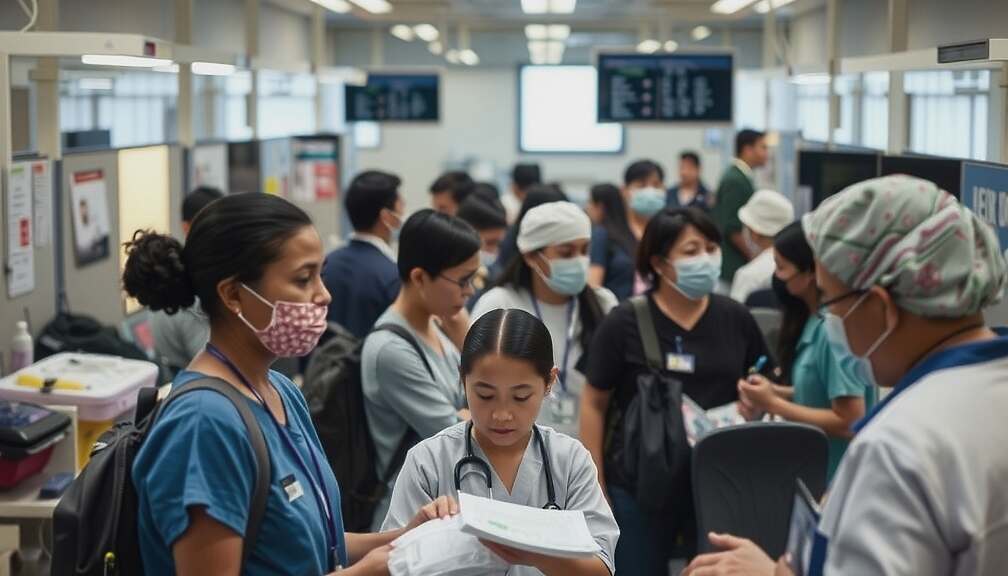
Germany’s government is forging ahead with plans to ease the recruitment of caregivers from India, a move spurred by recent discussions between Chancellor Friedrich Merz and Indian Prime Minister Narendra Modi. A memorandum of understanding (MoU) has been signed, signaling a formalized commitment between the two nations to establish standardized processes for the recruitment of Indian nursing professionals.
The agreement, negotiated between the German and Indian health ministries, is positioned as a dual-track solution aimed at addressing the critical shortage of caregivers in Germany while purportedly ensuring equitable and transparent recruitment practices. Health Minister Nina Warken (CDU) highlighted the significance of collaborating with India, the world’s most populous nation, to establish shared guidelines for attracting skilled caregivers from third countries. The goal, she stated, is to circumvent protracted and bureaucratic recognition procedures, enabling faster integration of qualified personnel into the German workforce.
Key to the MoU is the intention to promote internationally recognized standards, including Germany’s “Fair Recruitment in Nursing” quality seal, which mandates transparency, sustainability and cost-free application processes for prospective candidates. Furthermore, the initiative envisions the creation of “Global Skills Partnerships” (GSP), a framework for training aspiring caregivers according to both German and Indian curricula.
The GSP model proposes establishing training programs within India, aligned with national requirements and German industry standards. Crucially, these programs will incorporate intensive German language instruction up to level B2, alongside intercultural training to prepare individuals for the German healthcare environment. The document emphasizes that these initiatives are intended to expand training capacity and facilitate knowledge transfer rather than simply facilitating the poaching of already-qualified professionals.
However, critics are already raising concerns about potential long-term implications. While lauded as a solution to immediate staffing shortages, some experts caution that the reliance on foreign labor, even within a structured framework like the GSP, risks masking deeper systemic issues within the German healthcare system. Questions remain concerning the sustainability of the GSP model, the impact on the Indian healthcare system as caregivers are drawn away and whether the focus on recruitment detracts from broader efforts to improve working conditions and salaries within Germany to attract and retain domestic caregivers. The MoU, therefore, necessitates rigorous monitoring and evaluation to ensure it delivers on its stated objectives of fairness and sustainability and does not simply export Germany’s healthcare challenges onto another nation.