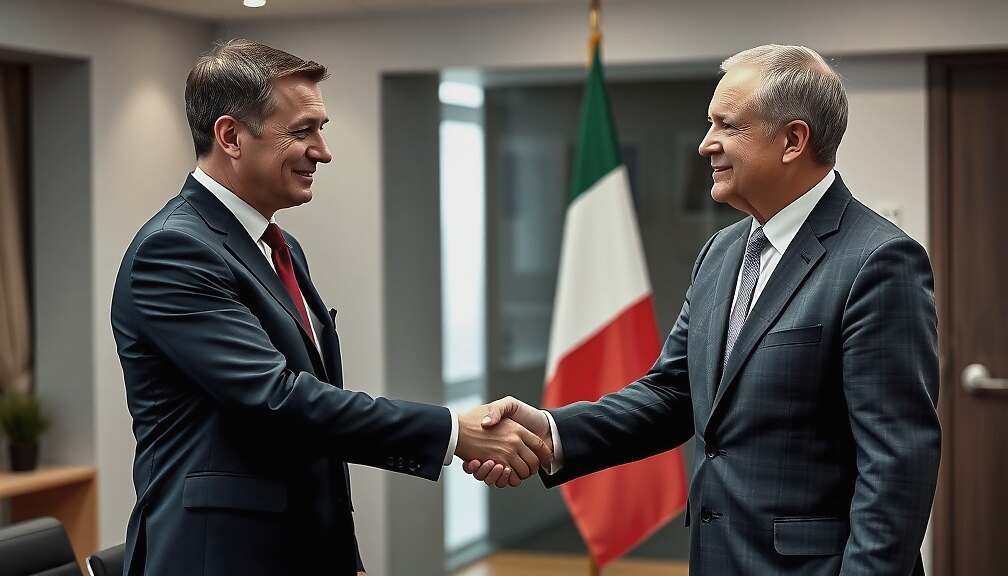
Germany and Italy have agreed to intensify their cooperation. At a joint press conference in Rome, German Chancellor Friedrich Merz (CDU) announced a newly signed German‑Italian action plan that both governments crafted over the last weeks. The plan aims to boost competitiveness, establish a fresh bilateral dynamic in the defence industry, and promote a proactive migration policy.
The two leaders signed a comprehensive agreement to deepen collaboration in defence manufacturing and to harmonise military procurement. They also pledged closer cooperation on internal security. Merz noted that “our alignment in European migration policy is already extremely close” and that it was only through this partnership that Germany and Italy were able to push through reforms of the EU asylum system in Brussels. In addition to the defence and security provisions, the pact includes a bilateral police agreement, an agreement on secret‑security cooperation, and a cultural initiative that traces Goethe’s route through Italy.
When Meloni thanked Merz for joining the informal “like‑minded countries” working group on migration, she highlighted the challenge of repatriating refugees and defending the EU’s external borders against smugglers.
Earlier in the meeting, Merz praised Italy’s new Arctic strategy in response to U.S. President Donald Trump’s claims over Greenland. He said Italy’s strategy aligns closely with Germany’s perspective, emphasising sovereignty and territorial integrity. “Denmark and Greenland can rely on our help and solidarity” Merz added, calling for support of talks between Denmark, Greenland, and the United States. He stressed that “in the new age of great powers, Europe must stand firm and sovereign”.
Merz and Meloni also urged the European Commission to propose fresh guidelines for cross‑border mergers. Merz explained that the goal is to enable EU‑wide mergers that create globally competitive companies, arguing that current European merger controls are too narrowly focused on a small market. They also called for easing capital requirements for banks.
At the next EU summit, Meloni plans to present a proposal to reduce bureaucracy, strengthen the single market, and “revive the automotive industry under the banner of technological neutrality”. She criticized what she sees as a particular ideological slant of the Green Deal that, according to her, has weakened industries without delivering measurable gains in global environmental protection.