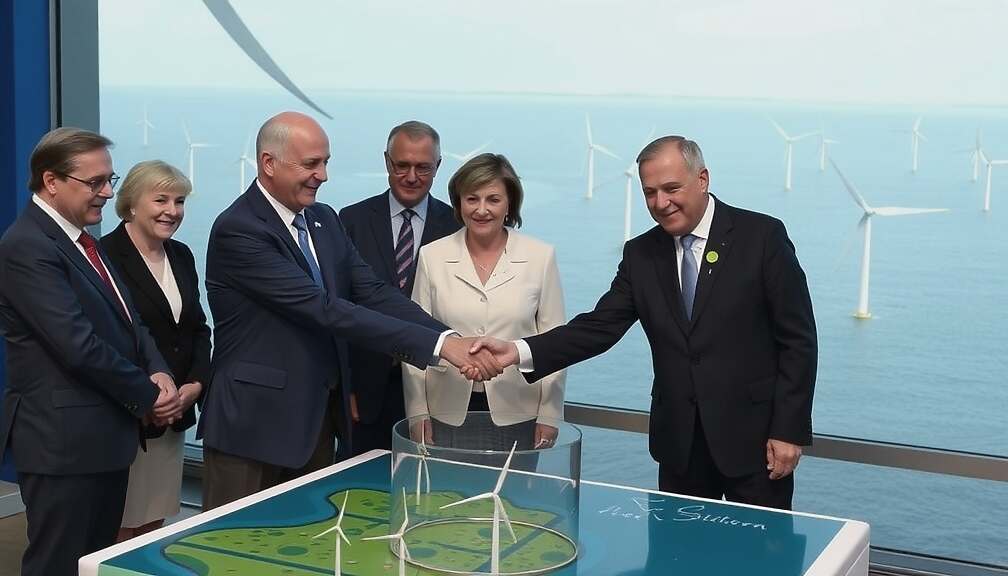
At the third North Sea summit in Hamburg, heads of state from several neighbouring countries agreed to deepen cooperation on expanding offshore energy. The meeting produced the “Hamburg Declaration”, in which the participants reaffirmed their ambition to make the North Sea the world’s largest hub for clean energy.
Their strategy will focus on offshore wind, the creation of cross‑border power grids, and stronger interconnections of energy infrastructure. Signatories of the declaration are Belgium, Denmark, France, Germany, Ireland, Luxembourg, the Netherlands, Norway and the United Kingdom.
The aim is to strengthen European energy security, stabilise energy prices, safeguard industrial competitiveness, and achieve climate neutrality by 2050. Recognising the geopolitical tensions that pose new threats-such as sabotage, cyber‑attacks and other hybrid attacks on maritime energy facilities-the declaration calls for closer international coordination on energy and infrastructure protection.
The states remain committed to the 300 GW offshore wind capacity target set at the previous North Sea summit in Ostend for the year 2050. To revive investment, they will speed up permitting, make procurement processes more reliable and reinforce supply chains. Simultaneously, European production capacities and port infrastructure are to be expanded.
In addition, the partners announced a stronger push for cross‑border offshore projects: up to 100 GW of the overall target could be achieved through joint ventures. They plan to develop a collective financing framework involving the European Commission and the European Investment Bank. Building a hydrogen economy around the North Sea also occupies a central place; projects that link offshore wind with the production, transport and storage of climate‑neutral hydrogen will be prioritised.
Finally, in light of mounting security risks, the participants support intensified collaboration to safeguard offshore energy infrastructure, including under the aegis of NATO. Measures foreseen include better coordination of security authorities, joint exercises and actions against substandard vessels.