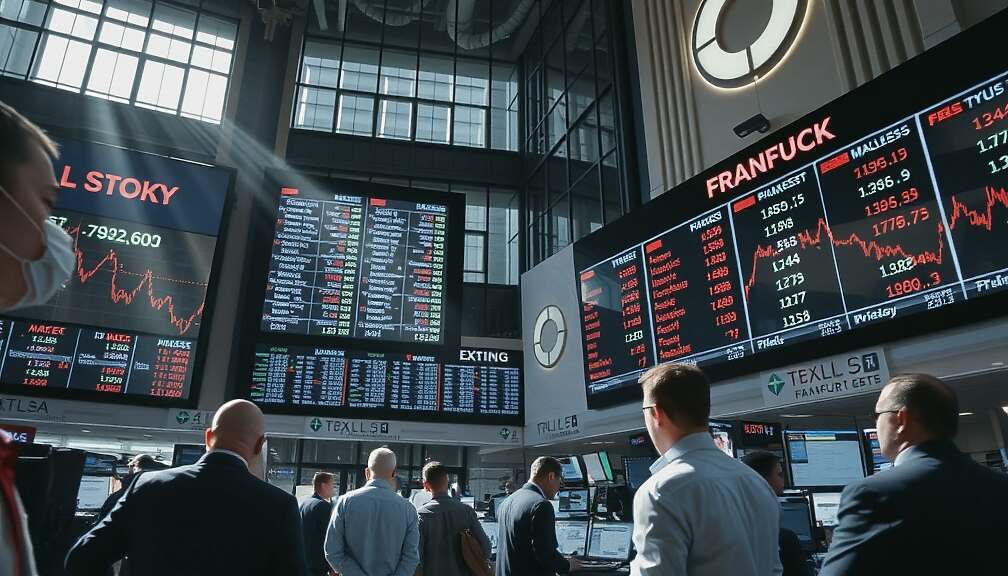
On Tuesday, the DAX slipped, closing at 24,894 points at the Xetra trading halt-down 0.2 percent from the previous day’s close. A strong start gave way to a quick retreat, and the index remained largely side‑ways around yesterday’s level throughout the session.
In the foreign‑exchange market, the euro strengthened in the afternoon: one euro was worth 1.1973 US dollars, meaning one US dollar traded at 0.8352 euros.
Christine Romar, Head of Europe at CMC Markets, commented that an euro‑to‑$1.20 level is not helpful for German exporters at present. She noted that a number of DAX stocks have underperformed compared with Wall Street, which has steadied after the “Greenland shock” and the mild de‑escalation in Davos. Romar highlighted that technology names are poised to lead the winners list ahead of tomorrow’s key data releases and Thursday night, potentially lifting the Nasdaq toward a new all‑time high.
She added that investors are fleeing the dollar amid political turbulence in the United States, yet they do not want to miss the continuing earnings momentum of US big‑tech firms. In Germany, the earnings prospect is comparatively muted, while expectations of a stronger euro ahead of the start of the reporting season are dampening sentiment. The euro trend, according to Romar, will play a role in outlook expectations.
In Frankfurt, the stock leaders just before the close were Rheinmetall and Fresenius. The bottom of the list included Qiagen, Deutsche Börse, Porsche, SAP and GEA.
Meanwhile, the price of natural gas fell. A megawatt‑hour (MWh) of gas for February delivery cost 39 €-a drop of 1 percent from the previous day-implying a consumer price of roughly eight to eleven cents per kilowatt‑hour (kWh) inclusive of all ancillary charges and taxes if the level remains steady.
Oil prices rose sharply: Brent crude for delivery in February traded at $66.69 per barrel as of 17:00 German time, up 1.7 percent from the prior trading day.