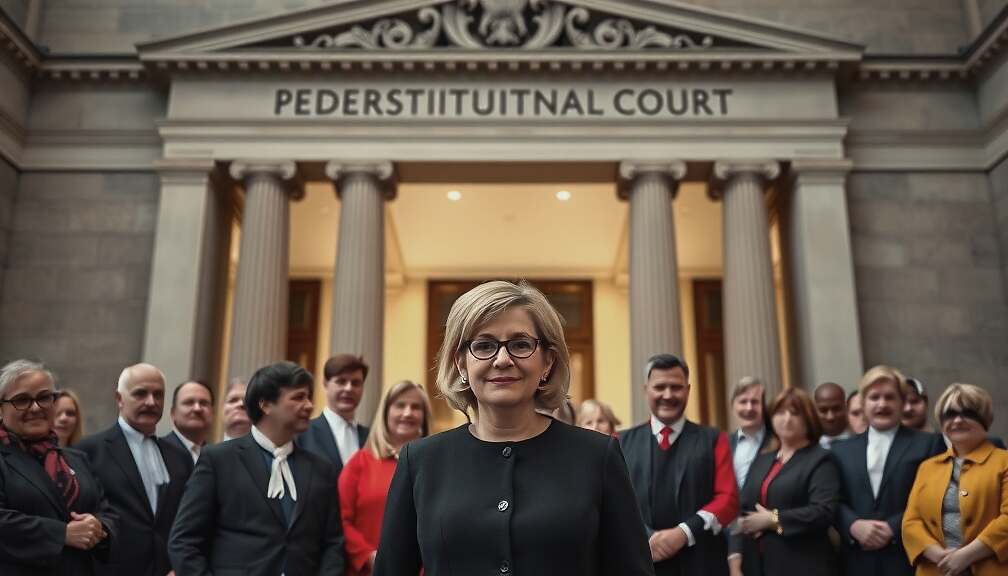
Ann‑Katrin Kaufhold, the newly appointed vice‑president of Germany’s Federal Constitutional Court, underlined how vital “diversity” is to the judiciary. “I consider pluralism in the court essential and believe everyone benefits from it” she told the “Frankfurter Allgemeine Zeitung”. “Certainly more diversity is imaginable”. Kaufhold said that thinking about and keeping this perspective in mind is primarily the responsibility of those who nominate constitutional judges.
She added that courts need people with different viewpoints who listen to one another and work toward shared solutions. “That kind of dialogue is increasingly at risk of being lost in society – it’s good that it works in Karlsruhe” she warned. Kaufhold also expressed frustration over how some of her scholarly remarks-particularly on “system supervision” and on “socialization” (‘Vergesellschaftungen’)-have been skewed.
On the question of legal personality for natural goods such as rivers, Kaufhold commented that it is worthwhile for legal scholarship to engage with the issue. “I haven’t taken a firm position: there are good arguments for and against it” she said. She criticized the way others deliberately misrepresent or manipulate her statements, citing a case where her descriptive‑analytical remarks on climate protection were re‑framed in tweets as normative judgments and political demands.
“Kaufhold added that she has described how courts today significantly influence whether-and how-climate protection is carried out” she explained. “Whoever analyzes worldwide jurisprudence comes to the same conclusion”. Whether that trend is commendable or not is a separate debate; constitutional‑law scholars debate it with appropriate nuance. She stressed that legislators must make the essential decisions, while courts merely set minimum requirements. “It was falsely asserted that I want to change that” she protested. Likewise, her habilitation thesis on “system supervision” was cited to imply she seeks to undermine the separation of powers-a claim she calls absurd and has no basis in her work. In her habilitation, she actually discusses financial‑market supervision.