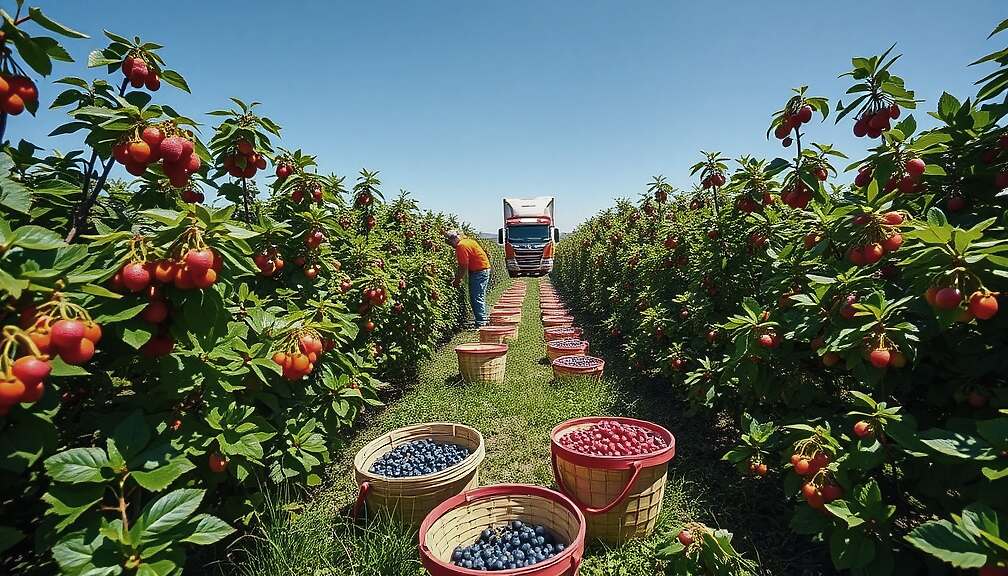
In 2025, Germany harvested a total of 45,700 tonnes of shrub‑berries on an area of about 9,000 ha. While the cultivated area fell slightly by 2.0 % compared with 2024, the yield rose by 23.5 %, announced the Federal Statistical Office (Destatis) on Tuesday.
The warmer weather in 2025, in contrast to the late frosts and drought that marked the poor 2024 harvest, was cited as the main reason for the strong increase. Compared with the six‑year average, the overall shrub‑berry harvest grew by 13.3 %. Since the survey began in 2012, the figure of 45,600 t reached in 2021 has now been surpassed.
The redcurrant (Kulturheidelbeere) remained the most important species. Its area of 3,450 ha shrank by 1.4 % from 2024, but it still accounted for roughly 38 % of the total shrub‑berry area and yield. With 17,300 t, redcurrants were harvested 14.4 % more than in 2024.
Following redcurrants, the largest harvests were for blackcurrants and white currants (9,300 t, a 37.3 % increase) . Raspberries yielded 6,200 t, down 11.1 %, while blackberries produced 5,900 t, a 107.4 % jump.
Shrub‑berry cultivation under greenhouse or other high‑tunnel covers expanded by 2.6 % to 590 ha in 2025, yet the yield fell slightly by 2.8 % to just under 6,500 t, according to the Federal Office. Raspberries constitute the majority (77.4 %) of the protected area. Since 2012, the protected raspberry area has plateaued around 450 ha, unchanged from the previous year.
Organic production covered 32.2 % (2,900 ha) of the total shrub‑berry area in 2025. Roughly 6,000 t of berries, representing 13.0 % of the total harvest, were grown under organic principles. While organic area dipped 2.6 % from the prior year, the yield increased 43.5 % compared with the weak 2024 season.
Relative to the six‑year average, organic shrub‑berry production rose 25.4 %, with 7,100 t in 2021 representing the highest organic total to date. Aronia (chokeberry) remained the leading species in organic cultivation at 870 ha, followed by redcurrants (590 ha) and sea buckthorn (480 ha). The largest organic yield came from redcurrants, with about 1,800 t, up 15.6 % from 2024, while aronia followed with roughly 1,500 t, a 194.8 % increase.