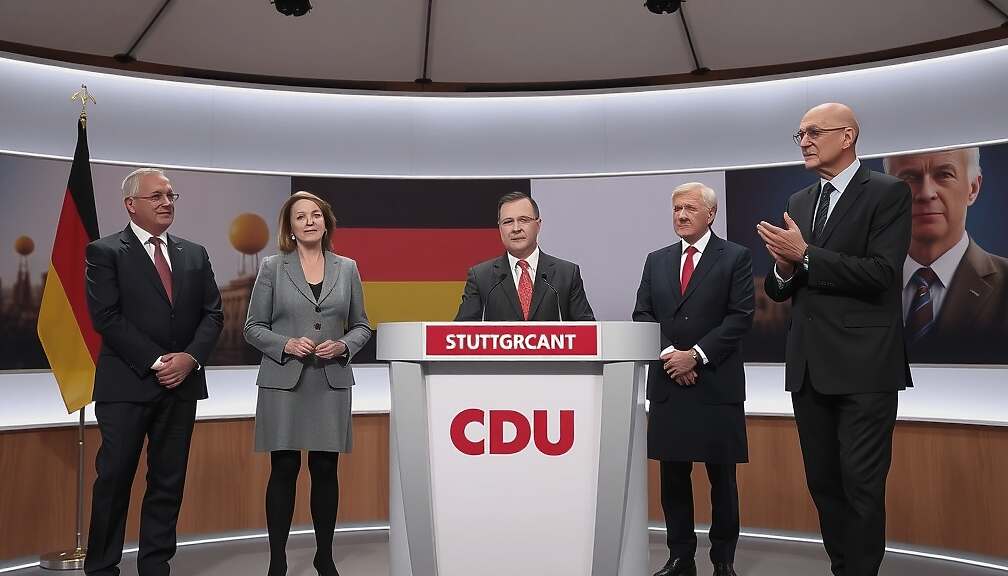
Ahead of the CDU federal party conference next weekend in Stuttgart, CDU politicians from the federal and state levels called for additional regulations on the use of social networks. Both Rheinland‑Pfalz party chairman Gordon Schnieder and CDU leader in Mecklenburg‑Vorpommern, Daniel Peters, expressed support for an age limit for social‑media usage.
“I consider the topic ready for decision” Peters told the “Welt” (Wednesday edition). “Since some time, the CDU in Mecklenburg‑Vorpommern has been demanding a minimum age for social‑media use. Children’s and youth protection must be the priority. We pay attention everywhere, but should social media be allowed to expose our youngest with unlimited content? With the highly problematic material that circulates, this is not acceptable”.
Schnieder urged a state‑wide ban on social media for children under 14. “If social media is demonstrably threatening the mental health of young people, we can no longer look away. I am convinced that where risks are proven, the state must set clear limits. This is especially true when it concerns our children” the CDU politician said.
The Schleswig‑Holstein CDU plans to put a 16‑year age limit and further rules-particularly targeting social‑network operators-before members for a vote at the party conference. According to a spokesperson, the party leadership would like to move the discussion to the party’s specialist committees after the application committee’s decision. The Northern CDU, however, insists on a debate and a vote on the matter. CDU state chief Daniel Günther is expected to table the corresponding motion at the conference.
Anne König, the CDU/CSU parliamentary group’s spokesperson on family policy, also supports a 16‑year age limit for social‑network use. “In the analog world there are clear rules to protect children” König told the newspaper. “In the digital space that consistency is often missing”.
Central socialization experiences are now happening less in family, school or public settings and more in privately run platform environments. “Thus the power of definition over attention, visibility and relevance shifts from democratically legitimized institutions to companies whose business model relies on behavioral control” the CDU politician noted. “The real power no longer lies with the child but with the algorithm. If the state stays away from this, it effectively forfeits one of its core protective functions: simply protecting our children”.