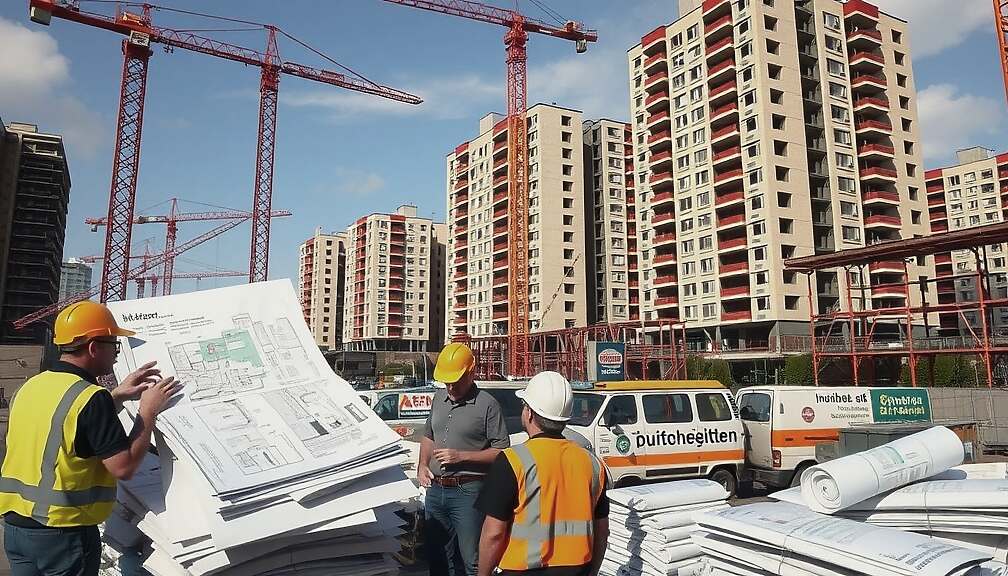
In 2025 Germany granted building permits for 238,500 residential units, according to preliminary results released by the Federal Statistical Office (Destatis) on Wednesday. This represents a 10.8 percent increase, or 23,200 units, compared with 2024, when the number of approved apartments fell to its lowest level since 2010.
For the first time since 2021, the number of permit approvals for apartments rose in 2025. The figures include permits for new-build units as well as for units created by converting existing buildings. The reported permits are an important early indicator of future building activity.
New-build units increased by 12.6 percent (22,100 units) to 198,100, while units created through conversion rose by only 2.7 percent (1,000 units) to 40,400.
Across all new residential buildings, 194,200 apartments were approved in 2025-13.2 percent, or 22,600 units, more than the previous year. Growth varied by building type:
” New single‑family houses saw a substantial rise of 17.2 percent (6,500 units) to 44,500.
” New two‑family houses remained essentially unchanged at 12,600 units, down 1.1 percent (-100) from the previous year. Together, single‑family and two‑family houses accounted for 28.8 percent of all new‑build apartments approved in 2025.
For new multi‑family homes, the most common building type and largely constructed by companies, authorities approved 128,100 apartments-12.1 percent, or 13,900 units, more than the previous year and comprising 64.6 percent of all new‑build apartments approved in Germany that year. The increase in multi‑family units surfaced in the second half of the year. New student housing also grew by 34.2 percent (2,300 units) to 9,100.
New non‑residential buildings received 3,900 apartment approvals in 2025, 10.3 percent, or 400 units, fewer than the previous year. Examples of this category include caretaker apartments in school buildings and residential units above commercial spaces in city centres.
Conversion of existing residential and non‑residential buildings accounted for 40,400 approved apartment units in 2025-2.7 percent, or 1,000 units, more than in 2024.
Approximately 95 percent of the 198,100 new‑build apartment approvals in 2025 were issued to private individuals and companies, highlighting their influence on the overall trend. Companies were responsible for 108,800 approvals-14.6 percent, or 13,900 new apartments, higher than the previous year. Private individuals accounted for 79,200 approvals-14.9 percent, or 10,200 units, more than the year before. Public‑sector applications for new‑build apartments fell by 23.2 percent (2,100 units) to 6,900.
In the non‑residential sector, new projects declined in 2025. Key building types include factories, warehouses, office and administrative buildings, and agricultural facilities. The central indicator of construction activity for non‑residential buildings is the volume of rebuilt space. In 2025, rebuilt volume declined by 5.2 percent to 183.1 million cubic metres-its lowest level since 2014 (186.8 million cubic metres).
Within this category, rebuilt volume fell by 17.1 percent in goods‑storage buildings, 13.0 percent in factories and workshops, and 37.8 percent in institutional buildings such as hospitals or nursing homes. Conversely, rebuilt volume increased by 24.9 percent in retail buildings and by 11.8 percent in agricultural facilities.