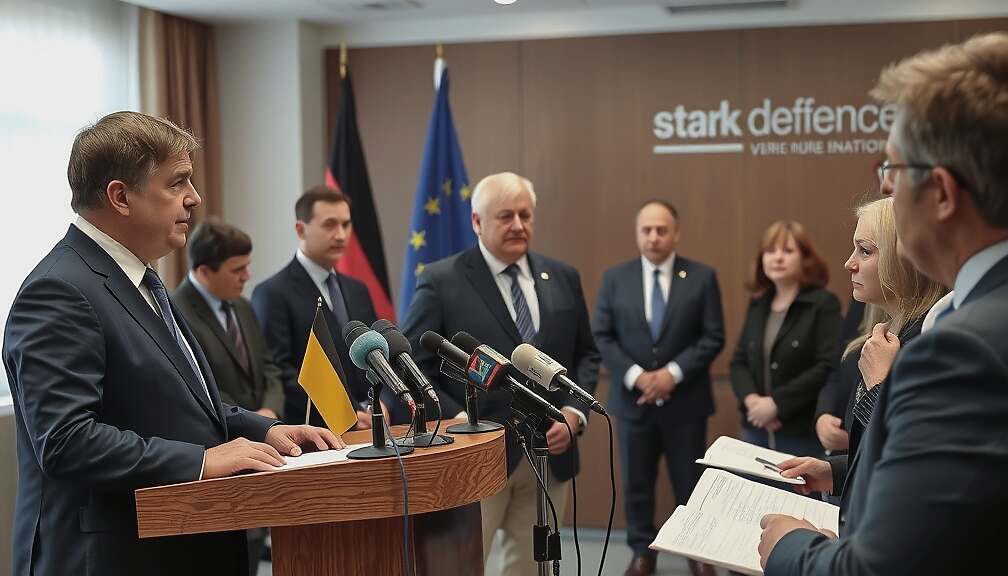
The German Defence Ministry does not see a reason to refuse the company the contract to supply kamikaze drones, even though the U.S. billionaire Peter Thiel is involved in the German start‑up Stark Defence. The conclusion is stated in an information paper the ministry sent to members of the Bundestag on Thursday, a release that was reported by the newspapers of the “Redaktionsnetzwerk Deutschland” (Friday editions).
According to the company’s own statement, Thiel – through his investment vehicle Thiel Capital – is just one of many minority shareholders. His shareholdings remain “under 10 percent”. He is not a board member, and the ministry notes that he has “no control or other special rights that would give him insight into or influence over the day‑to‑day management”. No shareholder, not even Thiel, is entitled to access the company’s technology, nor does he influence R&D or product decisions.
The document adds that should Thiel’s stake exceed the 10 percent threshold, an investment‑control mechanism would be triggered, allowing the state to stop any further increase in his participation. Confidentiality clauses are also in place to ensure that only personnel directly involved in implementation are privy to sensitive information.
Defence Minister Boris Pistorius told a troop visit on Tuesday that he “explicitly” shares the concerns of parliamentarians, particularly from the Greens, regarding Thiel. He said it must be clarified what influence Thiel has on Stark Defence. “If he has operational influence, if he holds a controlling minority in any form, we are dealing with a very different quality of engagement than if he is a one‑digit‑percent shareholder with no operational influence” Pistorius explained.
The Budget Committee is set to decide on the acquisition of the kamikaze drones on Wednesday. According to the ministry’s paper, contracts with Stark Defence and Helsing initially cover deliveries worth roughly €540 million, with the option for additional orders. Rheinmetall, Germany’s largest defence group, currently receives no contract because the results of its drone tests are “not yet sufficient”.
The ministry justifies the intended orders by stating that the national defence industry must be able to meet the Bundeswehr’s needs in a large‑scale conflict against a powerful adversary. This strategy mitigates the risk that hostile actions against a single system could cripple the entire army’s operational capability. At the same time, sufficient quantities will be available for the Lithuanian Brigade by early 2027.