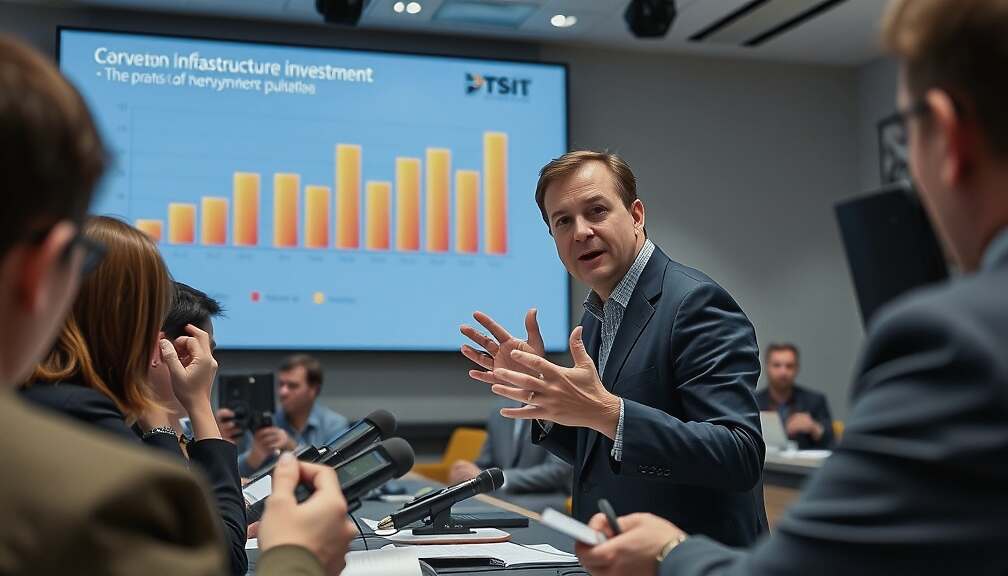
Despite the creation of the new Special Fund for Infrastructure and Climate Neutrality (SVIK), economist Jens Südekum warns of a looming long‑term investment backlog. “It must not be allowed to continue until a yearly wave of unspent investment money builds up” he told “Spiegel”, speaking as the personal adviser to Federal Finance Minister and SPD chairman Lars Klingbeil.
Südekum was referring to almost €30 billion in planned federal investment that had not been spent by 2025. He hopes construction will soon become faster and less bureaucratic, especially under the so‑called Infrastructure Future Act, which is intended to accelerate procedures in cases of overriding public interest.
Around a year ago, Südekum and three colleagues drafted a concept that served as the template for the special fund and for loosening the debt brake on defense spending. Even before their election, the federal government had set constitutional amendments in motion, fearing that they would become impossible to enact in the new Bundestag once the AfD’s influence grew. “We had to take the second step before the first” Südekum admitted. “In an ideal world, there would first be a master plan with various reforms. In practice, we have to organize implementation while the system is already running”.
Critics point out serious problems with this implementation, in part because the government has shifted money from the regular budget into the special fund. “This results in cross‑subsidies-for example, the reduced VAT in the hospitality sector is subsidised” said Oliver Krischer, the North Rhine‑Westphalia transport minister from the Green Party. “That is fatal”.
Krischer demands that the funding be distributed according to need rather than by a proportional allocation. He argues that his state has the worst rail network in Germany and therefore requires more urgent investment than other regions. €100 billion of SVIK funds are distributed to the Länder via the so‑called Königsteiner Schlüssel; the allocation increases with a state’s tax revenue and population.
If Krischer wanted to renovate the entire transport network-from county roads to the high‑speed ICE track and the autobahn-they would need approximately €130 billion, already more than the calculated share of his state in the special fund. “And still no school, hospital or university would be renovated” he warned.