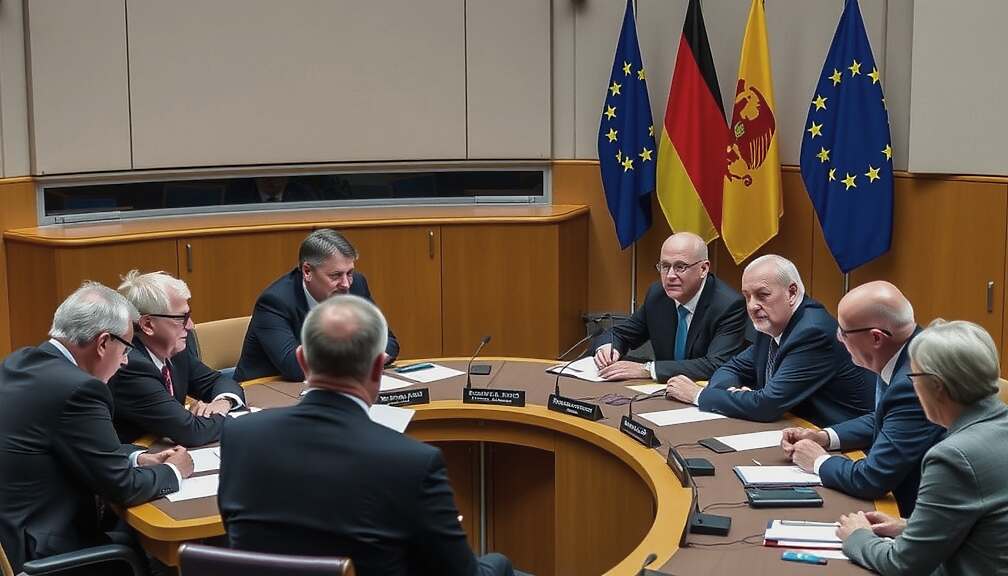
One of the most important priorities for the current coalition government-the reform of Germany’s debt brake-is at a pivotal crossroads. According to “FAZ”, the government’s reform commission, which is deeply divided, is now scrambling to agree on a joint proposal.
A compromise being debated involves tying the debt rule to the debt‑to‑GDP ratio. The core idea is that the federal government would be required to adopt stricter spending cuts whenever the share of public debt exceeds 60 % of GDP. At the same time, lawmakers are considering gradually eliminating the “sector exemption” that currently allows security‑related spending-including defence-to count only 1 % of GDP against the debt quota. That percentage could be raised incrementally as part of the new mechanism.
A heated contention remains between Union and SPD‑appointed experts over whether investment spending outlined in the constitution should be easier to finance through new credit. Yet a potential middle ground is shaping up. The current reform draft leans heavily on recent proposals from the Deutsche Bundesbank.
Last year the Bundesbank produced a concept that seeks to curb an unchecked rise in Germany’s debt ratio while simultaneously encouraging more federal investment and fostering higher economic growth. Under that framework, the government would receive only limited extra borrowing space if the debt ratio climbs above 60 %; if the ratio stays below 60 %, the additional leeway would be greater.
According to “FAZ”, this approach represents the last chance for consensus, because the fifteen‑member commission reportedly was on the brink of collapse in the days before. A final report is still due by the end of March, but the timetable is now becoming unrealistic. Presently, only a small core group from both sides is pushing the idea forward, and it still needs approval in a larger parliamentary setting.
If that fails, the commission may propose several conflicting alternatives that outline different ways to secure the long‑term sustainability of state finances. In that case, the decision would once again fall to the broader political arena.