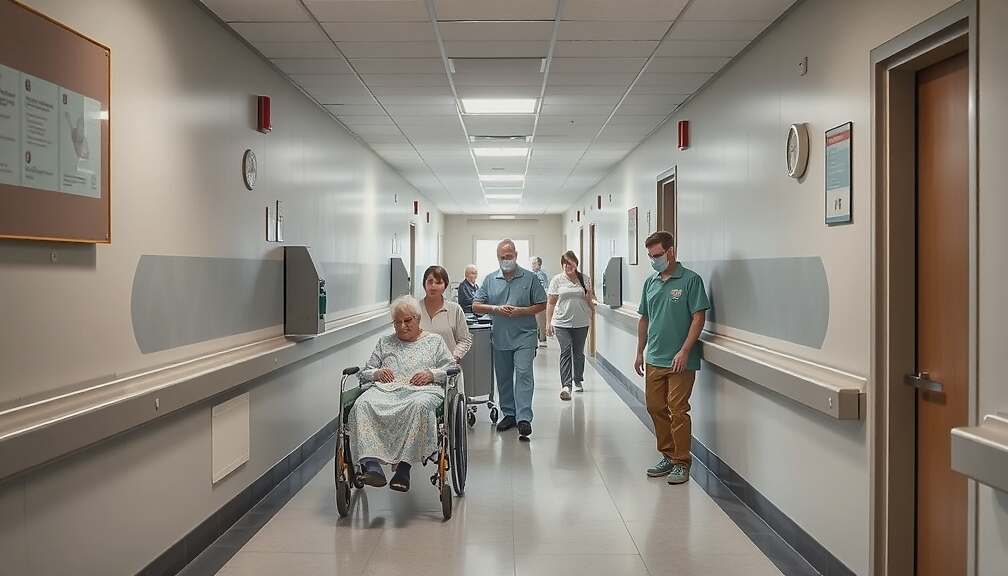
German Health Minister Nina Warken (CDU) plans that the overhaul of elderly care facilities will significantly increase the burdens on residents, according to drafts reviewed by the “Redaktionsnetzwerk Deutschland” from coalition circles aimed at plugging the billions of gaps in nursing care insurance. A key change involves the gradual increase of subsidies that residents currently receive, based on their length of stay, to lower their out-of-pocket expenses. Under the new proposal, these staggered subsidy increases will take effect more slowly than before.
For instance, instead of activation after twelve months, each incremental level will now only become effective after eighteen months. This means that residents will take longer to benefit from the successively increasing subsidies. Conversely, this change allows the nursing care insurance to save billions of euros in expenses. The plan stipulates that the 15% subsidy rate will apply not only during the first twelve but the first eighteen months in the facility. The subsequent increase to 30% will only take effect after the 18-month mark. Furthermore, the next tier of 50% will only apply after thirty-six months, rather than twenty-four months. The highest level of relief, offering a 75% subsidy, will now only be granted after a minimum residency period exceeding 54 months, compared to the current 36-month requirement.
Moreover, it will become more difficult for all insured individuals to be recognized as needing nursing care or to be classified into the lower care grades. Specifically, a higher degree of limitations will be required to achieve care grades 1, 2, and 3. This revision is expected to heavily influence the overall number of people requiring care, thereby impacting the insurance’s expenditures.
Additionally, the planned restriction on the fee-free family insurance in the health insurance system is set to be extended to the nursing care sector. According to the plans, a supplementary contribution of 0.7% will be required for co-insured spouses who are neither raising young children nor caring for relatives. Finally, similar to the health insurance system, the proposal includes making high earners pay more by raising the contribution assessment ceiling in the nursing care insurance. Whether this involves an ad-hoc increase of 300 euros, or a greater hike, remains undetermined.