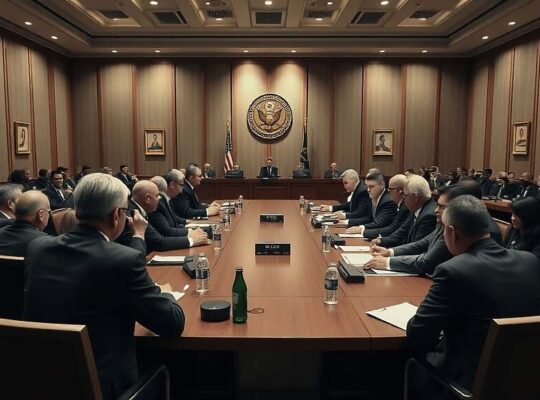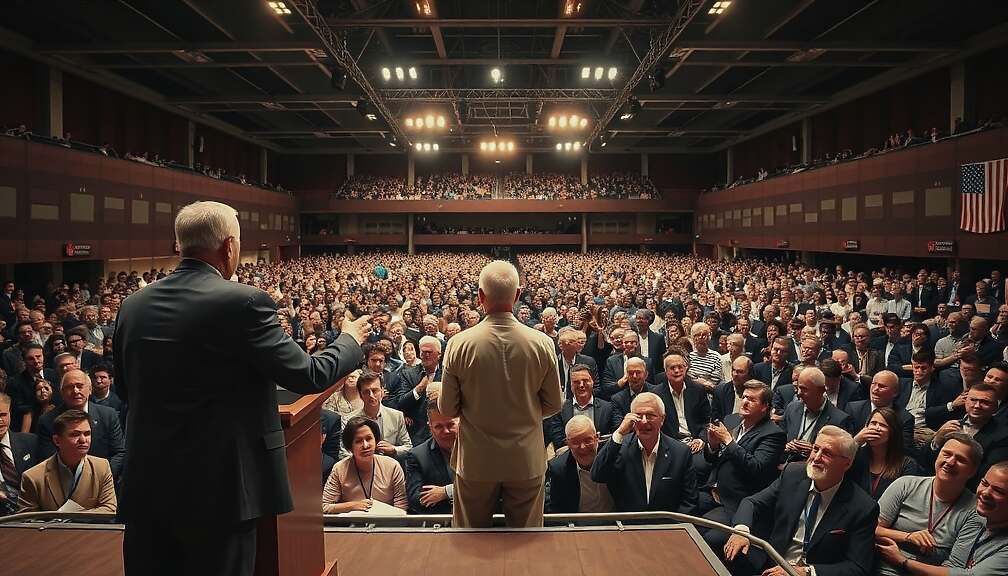
During his speech at the DGB Federal Congress on Tuesday, CDU leader Friedrich Merz faced mixed reactions, drawing both boos and laughter from the union delegates. In his roughly 30-minute address, Merz campaigned for broad cuts to the welfare state, pledged to modernize corporate co-determination, and called for a collective social effort, all while issuing stern warnings about the danger of accumulated reforms being postponed for too long.
Merz began by strongly asserting the importance of co-determination, stating that it represents “lived democracy in the workplace”. He emphasized that works councils, management, shareholders, and employees are usually better informed about what works within companies than politicians are. He committed the federal government to further strengthening this principle during the current term, specifically advocating for the introduction of online corporate assemblies and digital elections for works councils as alternatives to purely physical meetings. While the mood was initially positive, the audience’s demeanor gradually shifted as the talk progressed.
Shifting focus to the overall economic picture, Merz characterized the situation as “challenging, and it is demanding-in twofold terms”. He pointed out that geoeconomic upheavals are combining with decades of structural problems, creating a pressure to act that has not been felt in decades. He stated that the world is reorganizing itself-a process described as “eruptive, at times highly unfriendly and unpleasant, especially rapid”. Merz warned Germany could not escape this reality, listing rising energy prices, increased production costs, high living costs, and growing bureaucratic overhead as daily realities for countless families and businesses.
He strongly criticized the decline of German competitiveness, noting that “our economic development has stagnated for years, for at least seven years” while other surrounding countries have grown, in some cases quite rapidly. Merz predicted that Germany’s potential for economic growth would remain below half a percent in the coming years, calling this figure “too little” for the country’s prosperity and economy. He argued that economic growth is not an end in itself, but a prerequisite for jobs, tax revenue, infrastructure investment, internal and external security, and a viable welfare state, asserting that “without growth there is no affordable pension”.
Merz attributed this decline not only to external crises but largely to self-inflicted issues, claiming, “We simply failed to modernize our country”. He warned that postponing structural issues-specifically demographics and digitalization-is leading to repercussions. He criticized the loss of over 100,000 industrial jobs annually in Germany, attributing it not to a lack of efforts, but to the failure to address the issues for too long.
Despite the pessimism, the Chancellor attempted to instill a sense of optimism, conceding, “The good news is: We can change this”. He urged that stakeholders recognize that entrepreneurial initiative and corporate performance are essential for a thriving market economy, warning against approaching this initiative with “fundamental distrust”. He also stressed that workers must be relieved of pressure, and the society’s age structure must be addressed. “We cannot simply continue as we have for the last 20 years” Merz warned, “We must be ready for change-for change to preserve what is jointly important to us”.
On specific policy proposals, Merz detailed plans to stabilize the Statutory Health Insurance contribution rates for the foreseeable future, proposing that costs be capped while revenue sources are moderately adjusted through cost-of-living-linked co-payments. While keeping existing burden limits and generally maintaining subsidized family coverage, he acknowledged that the system would need modification.
The most difficult reform is slated to be the overhaul of the statutory pension scheme, Merz admitted. He mentioned that an expert commission would present proposals soon, allowing the government to make political decisions later that summer. He insisted this was not a political whim but a mathematical necessity driven by demographics, stating that “it exceeds the strength of two contributing payees if you are supposed to finance one person in retirement”. He thus advocated strengthening both the corporate and private pillars of retirement savings, confirming that no one in the country proposes cutting the statutory pension.
Furthermore, Merz championed better worker participation in the “productive assets” describing this as an unimplemented reform idea rooted in Catholic social doctrine. He clarified that this participation would have to happen via capital markets, aiming for the three main pillars-state, corporate, and private-to attain a new balance and provide a reliable total level of care higher than the state pension alone. This was particularly relevant for workers in Eastern Germany, who previously had little or no extra retirement provision.
Merz stressed the intention to implement the comprehensive recommendations made by the Social State Commission, leading toward a “fundamental reorganization of social benefits toward a simple, uniform, largely digital, and efficient system”.
The Chancellor also indirectly addressed his predecessor, Olaf Scholz, who had promised at DGB on May 9, 2022-shortly after the start of the Ukraine war-that the “turning point” would have no negative impact on social policy or workers. Merz refuted this guarantee, stating, “I must tell you today that this promise was at the very least too optimistic. The reality is that no one can avoid the changes today”.
However, when discussions arose about discarding the welfare state as a “burden” Merz definitively rejected the idea, making it clear to the entire government, “This will not happen with me”. He vowed, however, to pursue the necessary reform process to ensure the welfare state remains viable in its core.
Outside the realm of social policy, Merz set out other reform fields. He addressed energy policy, promising a “realistic and pragmatic approach” to bring prices under control, suggesting a return to regulation and the removal of hurdles for entrepreneurial activity, alongside modernizing state and administrative structures through an “ambitious federal modernization agenda”.
The government, he noted, plans investments in infrastructure, climate neutrality, and digital infrastructure of unprecedented scale. He used the newly approved data center strategy as an example: Germany’s computing capacity is set to double by 2030 compared to 2025. Merz concluded that Germany’s high-tech agenda, focusing on competitiveness, value creation, and sovereignty, would restore the nation to its rightful place globally-far advanced.
Concluding the speech, Merz issued a powerful appeal for focus on the common good, urging all participants to maintain fairness and look at the broader picture. He committed to making difficult decisions, stating, “we will not evade these decisions”. He also called on union representatives to participate constructively, asserting that their voice was vital to the democracy that defines the debate. Merz concluded with a generational promise: that future generations in Germany will have the same opportunities to live with freedom, peace, prosperity, and a very high degree of social justice. He asserted that the federal government, and he personally, stood behind this promise, eliciting a small degree of applause.