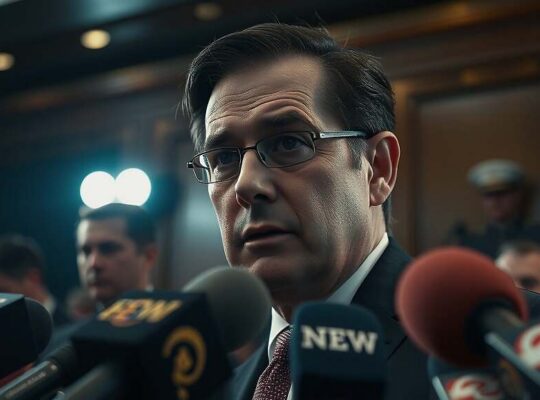
Julia Becker, a publisher at Funke, has sharply criticized the rival outlet Redaktionsnetzwerk Deutschland (RND) for publishing reports regarding a meeting between CDU leader Friedrich Merz and Axel-Springer CEO Mathias Döpfner. In a podcast broadcast by Paul Ronzheimer, Deputy Editor-in-Chief of “Bild”, Becker accused the RND of jeopardizing journalistic credibility by carelessly using unverified quotes.
The RND had published a podcast last week claiming that Döpfner reportedly threatened Merz with the words, “You will regret this,” after Merz allegedly declined a plea from Döpfner to soften the so-called “firewall.” However, the RND editorial team later retracted the story, admitting that the quotes should never have been disseminated. The Springer publishing house labeled the report a “lie,” while the German government dismissed it as “absurd rumors.”
Despite the controversy over the quote, a government spokesman, Stefan Kornelius, confirmed that a meeting between Merz and Döpfner did take place in the spring. Furthermore, Kornelius noted that after a board meeting, Merz had stated he had been urged by “some publishing houses” to seek “another majority in the Bundestag,” though he confirmed he would not do so. Kornelius told the dts Nachrichtenagentur on Friday that there was “no connection” between the meeting with Döpfner and the specific quotes in question.
Becker expressed profound disapproval of the RND for releasing the rumor. “If you aim at Döpfner and Merz, you have to be armed for that, I think; otherwise, you had better leave it alone,” she stated in the Ronzheimer podcast. She stressed the severity of the damage, arguing that “this chips away at all of our credibility-and credibility is the most important resource we have in our time. And that was carelessly wasted here.”
The publisher also chastised both media organizations and journalists for frequently seeking too close a relationship with politicians in the past. She maintained a stance of strict detachment, explaining, “I always had a bad feeling that politics and media sit on opposite sides of the table. This mingling or the assumption of ‘we are also privately good friends’-that creates too much closeness.”