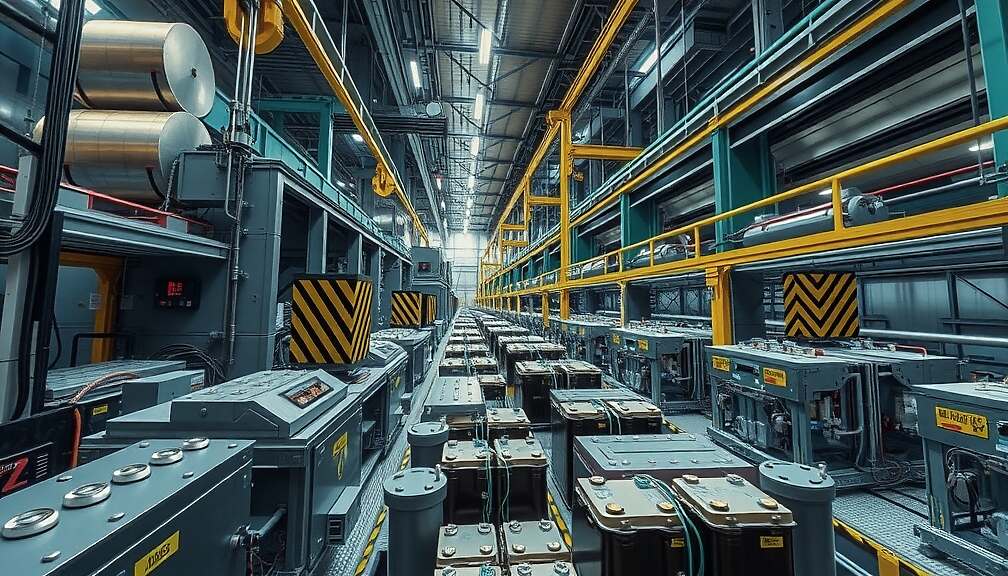
According to German industry leaders, the German nation is lagging in both speed and coordination when it comes to establishing its own European battery manufacturing sector. Stefan Wolf, CEO of the battery association, told the “Tagesspiegel Background” that “we are too hesitant to build sustainable future industries and mobilize the necessary investments for them.” He emphasized that collaboration between the state and the industry is essential, particularly because the automotive sector is currently struggling with sales and facing tightened financial margins.
Wolf noted that Chinese manufacturers benefited from massive subsidies over decades, allowing them to pursue the European market due to overcapacity in China. In contrast, the United States has adopted stringent barriers, which Wolf suggests makes Europe a kind of “lifeline” for Chinese conglomerates. He pointed out Tesla as an exception, noting that the company successfully industrialized the dry coating process and is now scaling it up at its Grünheide facility.
Despite considerable multi-billion euro subsidy programs, German government policy has not yet sufficiently implemented market-shaping mechanisms. Wolf argued that targeted demand incentives, alongside direct funding, are necessary. He used the metaphor of building a bridge to cross a “death valley,” stating that success requires parallel efforts on both sides: developing new technologies and creating demand for those new technologies. He cited the US model as exemplary, where tax credits are excluded for companies originating from China, Russia, North Korea, or Iran.
The association leader expressed criticism of the current federal government, noting that while the Ministries of Research and the Chancellery recognize the importance of battery technology, the Ministry for Economic Affairs has been too cautious. Despite recent setbacks involving companies like Northvolt, SVolt, Cellforce, and Varta, Wolf remains optimistic about a second round of substantial investment in countries such as France, Sweden, and the Netherlands. He stressed that battery technology remains “absolutely crucial for the future of our industry,” alongside microelectronics and artificial intelligence.
The urgency of these matters was highlighted by a recent Deloitte study which found that 98 percent of Europe’s major battery factories are operated by Asian companies, most notably the Chinese market leader, CATL.