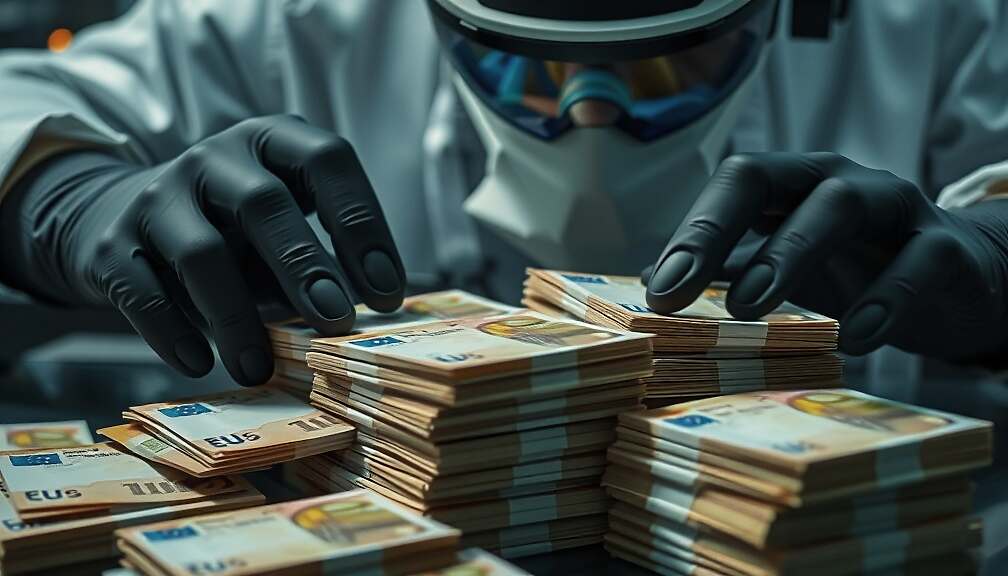
The Deutsche Bundesbank reported that during the first half of 2026, approximately 30,000 counterfeit Euro banknotes were discovered in German payment transactions, totaling a value of €1.75 million. According to the central bank, this represents a 4.3% decrease in the number of forgeries compared to the second half of 2025, with the total reported damage also falling by about 5.0% over the same period.
Lutz Lienenkämper, a board member at the Bundesbank responsible for cash, noted that the issue of counterfeit money in Germany remains relatively low, estimating that the incidence rate stands at only seven fake banknotes per 10,000 inhabitants annually.
While the number of fake 100-euro notes saw an increase, counterfeits of all other denominations declined. Nevertheless, Lienenkämper confirmed that the 50-euro note remains the most frequently counterfeited denomination. Furthermore, the quality of the fakes is changing; while “MovieMoney” or “Prop copy” were common in previous years, criminals are increasingly using variations labeled “Facsimile,” “Gecersiz,” or similar terms. These are simple fabrications that fail to reproduce any anti-counterfeiting measures and are therefore immediately recognizable upon inspection.
In contrast to the trend for banknotes, the number of counterfeit coins has increased. During the first half of 2026, roughly 64,900 fake coins were identified, up from around 59,700 detected in the second half of 2025-an increase of 8.6%. This means that approximately 15 counterfeit coins are found per 10,000 inhabitants per year. These fraudulent coins were exclusively found in the three highest denominations: 50-cent, 1-euro, and 2-euro coins.