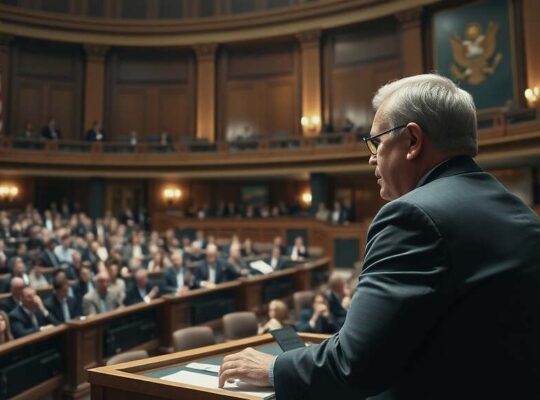
Former U.S. President Donald Trump recently made a dramatic threat, stating he would declare the Strait of Hormuz “territory of the United States.” He voiced this claim during a speech delivered to police cadets on Long Island in New York state. Meanwhile, his current administration continues its fruitless efforts to bring an end to the war against Iran.
The waterway is recognized as one of the most critical chokepoints for global trade, typically facilitating the transport of about one-fifth of the world’s oil exports by sea. Trump announced his intention to classify this strait as U.S. property “pretty soon.”
This statement comes at a time when peace talks with Tehran have reached an impasse. Iran refuses to reopen the route, which has been nearly fully closed since the commencement of the U.S.-Israeli attack in February. Even after nearly six months of conflict, no agreement is forthcoming. The U.S. is applying economic pressure on Iran by blockading its ports and shipping traffic.
During his address, Trump stated: “After we are done with the defeat of Iran, which will be very badly defeated, I will declare the Strait of Hormuz to be a territory of the United States quite soon.” He added, “Essentially, it is what it is. We have the blockade. No ships come through, unless we want them to.” At the time of the announcement, it was unclear whether his declaration was meant seriously or whether it represented a new official policy direction for the administration.
In response, Iranian Vice Foreign Minister Kazem Gharibabadi asserted that Tehran would not be intimidated by threats or military displays of power, adding that the Strait of Hormuz is under sole Iranian control. Foreign Minister Abbas Araqchi clarified that Iran had not yet decided on resuming talks with Washington. He stressed that contacts via Qatar and Pakistan were not negotiations, and discussions with Oman were only concerned with defining a shipping route. Araqchi made it clear that the U.S. must fulfill certain conditions before shipping could resume.
Trump had previously claimed that the U.S. possessed “total control” over the strait, which is an international waterway bordered by Iran and Oman.
Since the start of the war, gasoline prices have risen significantly. Trump defended this added burden on consumers, arguing that those willing to pay “a tiny bit more” should do so to prevent “a very evil country” from acquiring a nuclear weapon, a position he stated he would not apologize for.
Over the past months, the U.S. government has repeatedly proclaimed victory in the war while urging the Iranian regime toward a resolution. Tehran, conversely, is demanding a “correction” of U.S. behavior, full compensation for war damages, the lifting of sanctions, and the unconditional release of frozen assets.