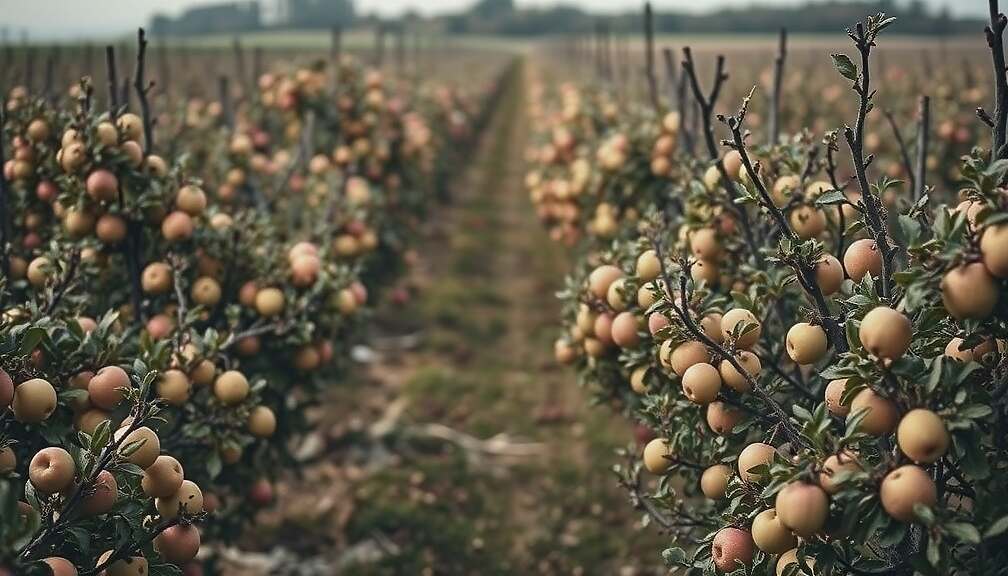
According to a preliminary estimate released by the Federal Statistical Office (Destatis) on Tuesday regarding the 2026 harvest season, German fruit producers anticipate yielding approximately 934,000 tons of apples. Despite apples remaining the most extensively cultivated fruit in Germany, covering 32,700 hectares nationwide, this forecast suggests a decline of 52,900 tons, or 5.4 percent, compared to the average of the last ten years (2016 to 2025).
This expected volume represents a substantial reduction, falling short of the previous year’s notably good apple harvest by an estimated 204,000 tons, or 17.9 percent. For the 2026 season, an average yield of approximately 28.6 tons per hectare is projected.
The subdued harvest forecast is attributed to recurring heat cycles and prolonged drought conditions during the spring and summer of 2026. These weather challenges have led to premature fruit drop, resulting in many undersized apples, instances of sunburn damage, and localized, almost complete crop losses due to hail in certain orchards.
Baden-Württemberg and Niedersachsen are expected to shoulder the bulk of the 2026 harvest, together accounting for 61.1 percent of Germany’s apple-growing area and producing two-thirds (66.6 percent) of the nation’s supply. In Baden-Württemberg, 11,600 hectares are expected to yield 350,000 tons, which is slightly above the ten-year average by 0.7 percent. Conversely, Niedersachsen anticipates a harvest of 272,000 tons from 8,400 hectares, marking a 5.9 percent decrease from the ten-year average.
Other states face even sharper declines; Thuringia is expected to see a decrease of 45.1 percent, while Mecklenburg-Vorpommern (-18.4 percent), Bavaria (-16.4 percent), Rhineland-Palatinate (-15.8 percent), Saxony (-13.3 percent), and Hamburg (-12.8 percent) are also forecasted to be significantly below the recent average.
In terms of plums and prunes, the forecast for 2026 (based on the July preliminary estimate) is positive. The yield is expected to reach around 49,300 tons, which is 5,100 tons-or 11.5 percent-higher than the ten-year average (44,200 tons). Although this production is forecast to be 3.9 percent lower than the extremely productive previous year, the expected yield for plums and prunes averages about 12.0 tons per hectare across the approximately 4,100 hectares cultivated.
Baden-Württemberg, the region most critical for plum and prune cultivation, is forecast to produce a particularly strong harvest of around 24,100 tons from 1,700 hectares. This figure represents a 37.8 percent increase over the ten-year average and a 34.4 percent improvement over the substandard harvest seen in Baden-Württemberg the year before. In Rhineland-Palatinate, the second largest growing area (around 900 hectares), the current projection is less favorable, predicting 9,900 tons, which falls below the ten-year average by 7.7 percent.