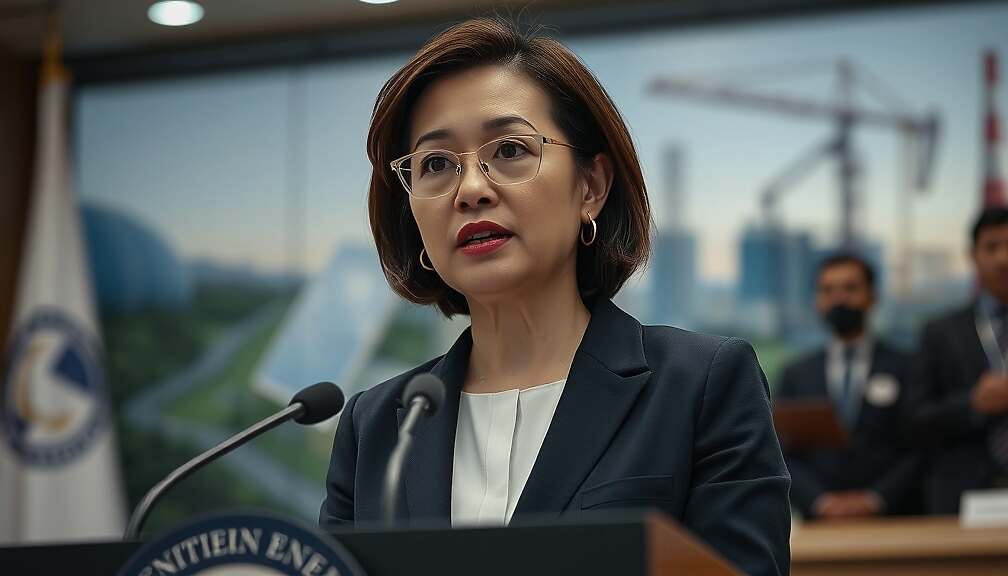
Federal Economic Minister Katherina Reiche (CDU) has forcefully addressed allegations that she aims to undermine Germany’s energy transition and climate-friendly structural changes, dismissing these accusations as “nonsense,” she told the “Süddeutsche Zeitung”. She noted that Germany has surpassed initial targets for the rollout of both solar photovoltaic and wind installations in both the past and the current year. However, she acknowledged that despite 30 years of climate policy costing nearly one billion euros, the share of renewable energy in total energy consumption remains at only about 20 percent. The minister stressed, “This shows that transformation is necessary, but it requires time, it costs money, and it does not proceed linearly. We must constantly review, make adjustments, and correct things if needed.”
Minster Reiche also reassured the public that Germany is not currently facing a shortage of gas this winter, even with relatively low storage levels. She stated, “As of today, there is more gas in the storage facilities than was consumed even during the coldest year.” Nevertheless, she confirmed that the federal government plans to establish a strategic reserve to protect citizens and businesses against unforeseen events, although this reserve will not be available until the winter after next.
Regarding political speculation that the CDU/CSU might allow the unpopular coalition with the SPD to collapse, form a minority government, or even seek support from the AfD on specific matters, Reiche issued a decisive rejection. “We were elected, we have taken on government responsibility, and there is a clear expectation from citizens and businesses that we will deliver-and we are delivering,” she said. “For me, there is no alternative to this coalition.”
She attributed the significant support for the AfD, particularly in Eastern Germany, among other factors, to the prolonged economic stagnation in the country. Many citizens are worried about losing their jobs in industries like automotive, steel, or chemicals due to the current crisis. The native Brandenburger described this situation, noting, “Unfortunately, this is also true in the western part of the country. But for many citizens in the new states, this feels like the second major setback in their lives.” She continued, “We like talking about transformation, but for those affected, it can feel as though the ground has been pulled out from under them again, forcing them to reorient completely.”
The Minister remains optimistic about Germany’s ability to overcome the current structural economic crisis. “We have everything we need for a fresh start. We have excellent skilled workers, magnificent scientists, and great founders. We have the necessary capital to invest in young, promising companies-thanks to the new stock dividend. Furthermore, we remain world-class in many areas,” she asserted. The Republic of Germany therefore has every chance of winning the global race to adopt artificial intelligence in industry. However, Reiche stressed that a condition must be met: “We must want to win again and not settle for being a good second place.”