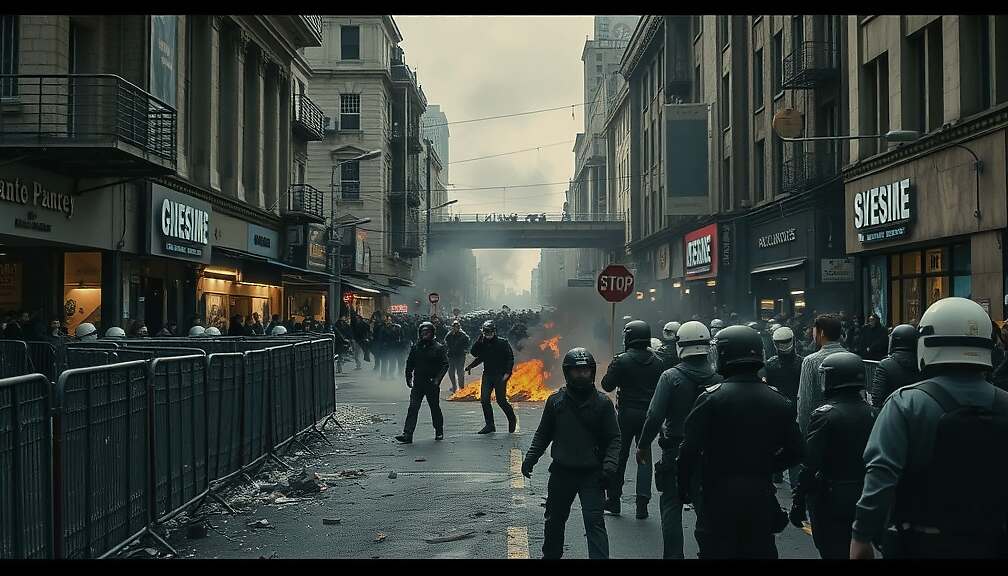
Günter Krings, the Vice-Chairman of the CDU parliamentary group in the Bundestag, is advocating for a legal change modeled after the French system to address damages caused by public unrest. Speaking to the “Welt” newspaper, he stated that Europe must find a new method of dealing with “these dilapidated groups that refuse to integrate anywhere in the EU,” arguing that the rule of law can only respond with “maximum severity and consistency.” Krings noted that any perceived weakness in the state order is often misinterpreted as an invitation for violence and looting.
He specifically endorsed civil liability, stating it is “definitively” necessary. Echoing former French Prime Minister Gabriel Attal, the argument is that anything broken must be repaired, and anything soiled must be cleaned. To implement this, he argued, new co-liability rules are needed because proving individual, concrete damage during such events is extremely difficult. People who participate in riots should be held collectively responsible for the resulting damages.
Krings also supported the view of Federal Interior Minister Alexander Dobrindt (CSU), which holds that the riots were primarily driven by left-wing extremists and migrant communities, who hijacked the protests of students and pupils. He claimed that while security authorities are still evaluating the events, initial findings clearly show that about 95 percent of those arrested in Frankfurt were from immigrant families. He added that other rioters were characteristically prepared with Molotov cocktails, weapons, homemade pyrotechnics, and masks.
In his view, these are essentially the same groups involved in riots and looting in France and other European countries, and that these criminal activities are unrelated to students and pupils who demonstrated for legitimate causes.
However, Clara Bünger, the head of the Left Party’s security committee in the Bundestag, views the idea of co-liability critically. She noted that those who demonstrably cause damage can still be held accountable under current law without needing new legislation, citing paragraphs 823 and 830 of the Civil Code. Bünger expressed concern that the current discussion goes far beyond this: it suggests that people should pay for damages they did not personally cause. She deemed this highly problematic, fearing it would discourage people from exercising their right to protest. She stressed that a blanket liability for demonstrators is incompatible with the right of assembly guaranteed under Article 8 of the Basic Law.
Konstantin von Notz, the Deputy Chair of the Green parliamentary group and the Parliamentary Control Panel, also strongly criticized the prime minister’s remarks. He agreed that Dobrindt’s subsequent clarification was necessary, noting the urgency of addressing the implication that the Interior Minister was singling out specific demographic groups. Von Notz suggested that these types of discussions focused on division and urban landscape issues do little to improve security policy in Germany. He expects the Interior Minister to continue tackling violence and criminal acts with the necessary seriousness, regardless of who commits them.
Heiko Teggatz, Chairman of the German Police Union, acknowledged the logical grounding of expanding co-liability while expressing skepticism about whether the French model can be transplanted one-to-one into Germany, given their differing legal systems. He pointed out that in Germany, claims for damages are typically enforced through civil law, unlike in France. Therefore, implementing a comparable model in Germany would face significant legal hurdles.
Teggatz concluded that the key question is what extra benefit a new model would truly offer. Instead, he argued it would be more effective to consistently apply existing instruments-tightening procedures, accelerating prosecution, and holding perpetrators accountable faster and more visibly. Teggatz supported Interior Minister Dobrindt’s assessment, stating that targeting known groups is not a blanket suspicion of entire populations but rather behavior-based policing. He stressed that police rely on consistently analyzing intelligence about perpetrator structures, behavioral patterns, and networks, including forensic methods like suspect portrait analysis and grid searches, with the ultimate goal of preventing crimes early and holding those responsible accountable.