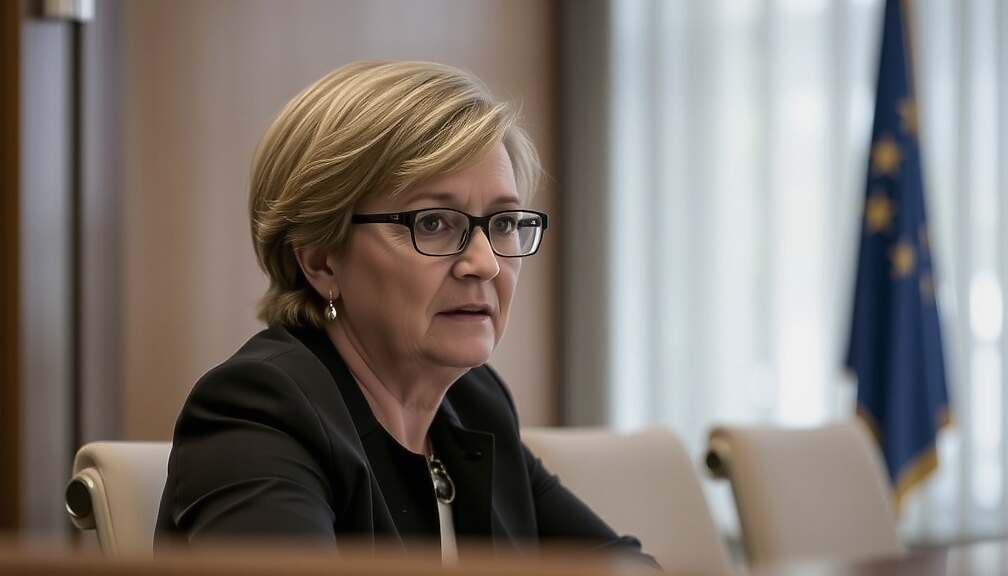
Austria’s Foreign Minister Beate Meinl-Reisinger urges other EU states to quickly agree on the substantive issues of the European negotiating delegation for the Ukraine talks. Meinl-Reisinger told the Frankfurter Allgemeine Zeitung (Monday edition), “This team urgently needs a substantive mandate. We must be capable of action and decision-making. And above all, we must formulate our interests.”
In the FAZ, Meinl-Reisinger cited a specific proposal she plans to submit to the EU Foreign Ministers Council on Monday. “We want to divide the negotiating scope into four thematic pillars,” she said. She named politics, security, humanitarian issues, and economy as the corresponding areas. Meinl-Reisinger said that coordination within the EU is urgently needed in the area of politics, as there has been the impression that there is no coordination at all so far. Furthermore, she mentioned the need for coordinated engagement with other institutions that play a role, such as NATO, the OSCE, the “Coalition of the Willing,” or the Council of Europe. Meinl-Reisinger also highlighted the economy. “Here, it is about pressure points, but also incentives for lasting peace and reconstruction. The EU has significant leverage in that regard.”
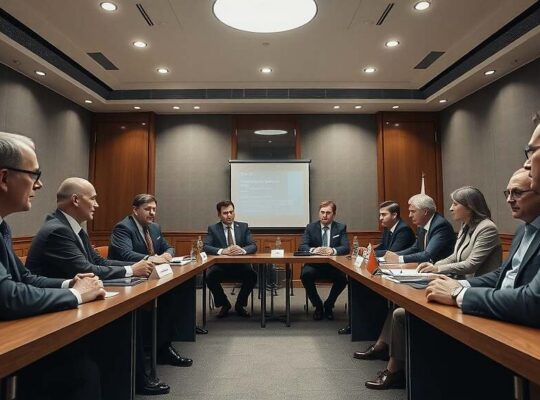
On Friday, EU states agreed following long deliberations at an informal summit in Dublin to expand the European negotiating delegation for talks with Russia, the USA, and Ukraine. This delegation was previously essentially composed of representatives from Germany, France, and the United Kingdom. In the future, Italy and Poland will also send one negotiator each within an “E5” format. Representatives from the European Council, the EU Commission, and NATO will also be included.
Meinl-Reisinger welcomed this solution, even though it primarily secured a place at the negotiating table for the most powerful states in Europe. “The E5 reflect who brings the greatest military and political weight to these negotiations in Europe. That is legitimate,” she told the FAZ. “However, what is crucial is that the EU institutions are part of the team-the Commission and the Council. And the Council, that is all 27.” This ensures that the team speaks for the entire Union. “Everyone must stand behind it. And we can achieve this by issuing a clear European mandate and jointly shaping the content.” This is why Austria will submit its proposal for a substantive structure to the Foreign Ministers Council.