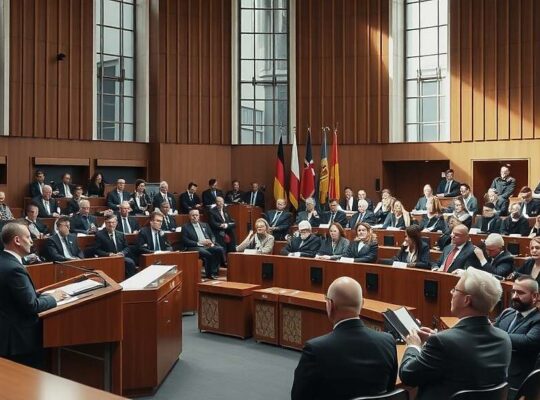
The political landscape in Brandenburg remains in turmoil following the failed attempt by the Alternative for Germany (AfD) to dissolve the state parliament. The motion, tabled on Friday, was decisively rejected by the Social Democratic Party (SPD) and the Christian Democratic Union (CDU), the potential partners in a future governing coalition. Notably, the parliamentary group of the “Basiswürde Solidarität Humanität” (BSW) voted alongside the AfD, highlighting a deepening fragmentation within the political arena.
AfD parliamentary group leader Hans-Christoph Berndt launched a scathing critique, accusing the BSW of betraying the electorate through the defection of two of its members to the SPD. This shift, he argued, fundamentally undermines the democratic mandate and demonstrates a disregard for voter preferences.
The extraordinary session followed closely on the heels of Minister-President Dietmar Woidke’s (SPD) abrupt termination of the coalition agreement with BSW just days prior. Woidke justified the decision, citing the disintegration of the BSW parliamentary group through resignations and a perceived lack of commitment to the coalition’s shared goals. He vigorously dismissed the prospect of new elections, instead opting to govern with a fragile minority government and pursuing a fragile alliance with the CDU, which would secure a narrow majority.
Further exacerbating the instability, the BSW parliamentary group unexpectedly voted in unison with the AfD for a motion to remove Jouleen Gruhn from her position as parliamentary vice-president. Gruhn’s recent departure from the BSW to join the SPD, a move deemed by the AfD to invalidate the original basis for her election to the presidency, was the direct cause of the motion. The motion itself was ultimately unsuccessful, but the vote itself signifies a worrying normalization of cross-party collaboration with a party positioned on the far-right and underscores the precarious nature of the political alliances currently holding Brandenburg together. The incident raises serious questions about the integrity of the parliamentary process and the vulnerability of established political arrangements.