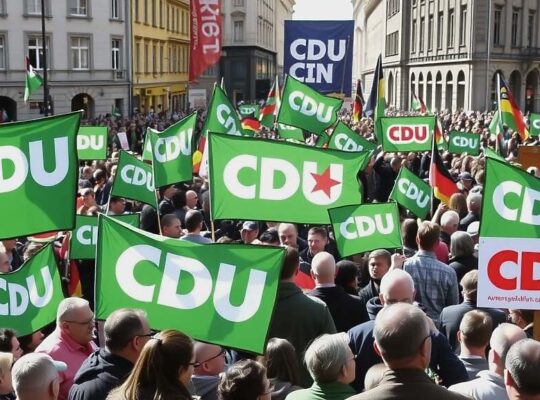
a reduction in electricity tax for all consumers.. Two significant CDU affiliated organizations, the Mittelstands- und Wirtschaftsunion (MIT) – the Union of Medium-Sized Businesses and the Economy – and the Christlich-Demokratische Arbeitnehmerschaft Deutschlands (CDA) – the Christian Democratic White-Collar Workers’ Association – are poised to table motions at the upcoming CDU party conference in Stuttgart on February 20th and 21st, according to reports in “Welt”.
The MIT’s proposed motion directly calls for an expansion of electricity tax cuts to encompass all consumer groups, including private households, the retail and service sectors and the entire crafts industry. The rationale centers on the persistent high cost of energy in Germany, branding it “considerably elevated and, in many cases, internationally non-competitive”. The MIT argues that a significant reduction in state-imposed energy costs is therefore a necessity.
Gitta Connemann, Chairwoman of the MIT, emphasized the burden on the Mittelstand – Germany’s backbone of small and medium-sized enterprises. “Every Mittelständler is burdened by energy costs” she stated, highlighting the impact on businesses ranging from bakeries to retail outlets and skilled trades. Connemann framed the proposed reduction not as a mere tax break, but as a crucial economic imperative, asserting that supporting value creation within Germany requires alleviating business costs.
The CDA’s motion takes a slightly different angle, emphasizing the disproportionate impact of rising energy costs on lower and middle-income households. They argue that while inflation has stabilized, many families continue to feel the squeeze of higher living expenses. Their proposal calls for a reduction in the electricity tax across all consumer groups to the European minimum level within the current year, a move they anticipate will benefit both households and the Mittelstand.
The convergence of MIT and CDA on this issue is noteworthy. These organizations, alongside the Jungen Union (Young Conservatives), represent some of the most influential factions within the CDU, frequently advocating for divergent policy positions. Their unified stance on electricity tax reduction significantly amplifies the likelihood of the motion gaining traction and being adopted at the party conference, potentially forcing Chancellor Merz’s hand and revealing the depth of internal political divisions on economic policy. Critics may view the proposal as another example of politically expedient measures before tackling deeper structural issues within Germany’s energy sector and overall competitiveness.