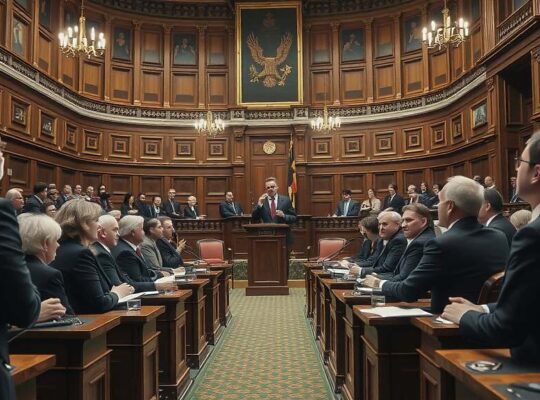
A prominent voice within the Christian Democratic Union (CDU) is issuing a call for introspection amongst centrist parties in Germany, particularly ahead of the 2026 state elections. Anna Aeikens, a member of the Bundestag representing Saxony-Anhalt, argues that simply opposing the rise of the Alternative for Germany (AfD) is insufficient to regain public trust.
Speaking to the “Rheinische Post”, Aeikens stressed the need for centrist parties to articulate a compelling vision, focusing on tangible issues such as social security, economic opportunity and a robust democracy – especially critical in eastern Germany where disillusionment has fueled support for populist movements. Her remarks mark a subtle but significant shift in strategy, suggesting an acknowledgment that existing approaches haven’t fully addressed the concerns driving voters towards the political fringes.
While Aeikens points to a recent “Saxony-Anhalt Monitor” study indicating a high degree of satisfaction with life among the population and considerable trust in the state government and parliament – reflecting 23 years of CDU leadership – she contends that maintaining this momentum requires more than passive governance. The study’s findings, while superficially positive, arguably obscure underlying anxieties and a desire for more proactive solutions to pressing economic and social challenges.
The call for self-criticism is also perceived by some analysts as a preemptive defense against potential criticism. By proactively highlighting the CDU’s track record, Aeikens aims to counter narratives portraying the party as out of touch or unable to address the root causes of discontent fuelling the AfD’s ascendancy. The underlying question remains: can the CDU and the broader democratic center, effectively bridge the gap between expressed satisfaction and the demonstrable shift in political alignment, or will the focus remain solely on opposition, ultimately leaving the space for radical alternatives to thrive?