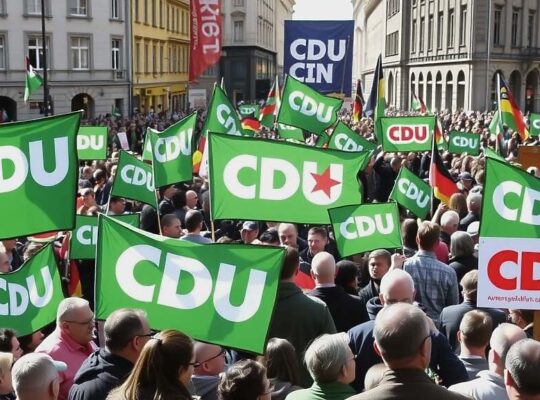
The Christian Democratic Union (CDU) is escalating the debate surrounding extremism in Germany, with a senior parliamentarian issuing a stark warning against the perceived downplaying of left-wing extremist activities. Alexander Throm, the CDU/CSU parliamentary group’s spokesperson for domestic policy, criticized what he described as a reflexive deflection tactic employed by left-leaning circles whenever left-wing extremism is addressed, arguing it “relativizes” the issue and must end. He underscored a principle of equal treatment in combating all forms of crime, terrorism and extremism, rejecting the notion of a prioritized hierarchy.
Throm’s comments come amidst ongoing discussions surrounding the expansion of powers for Germany’s intelligence agencies, a move championed by Interior Minister Alexander Dobrindt (CSU). Dobrindt’s plans to grant security services increased authority, particularly regarding IP address tracking and the issuance of protective orders, are framed by Throm as essential for effective threat prevention. He argued that these capabilities should not be limited to the Federal Criminal Police Office (BKA), but also extended to the agencies tasked with constitutional protection.
The debate is further complicated by the recent arson attack on Berlin’s power grid, widely suspected to have been perpetrated by left-wing extremists, which has accelerated the push for broadened surveillance powers.
While the Social Democratic Party (SPD), the CDU’s coalition partner, acknowledges the urgency of the situation, they are emphasizing a less politically charged approach. Sebastian Fiedler, the SPD’s domestic policy spokesperson in parliament, advocates for bolstering the personnel and resources of investigative bodies, continuing a path laid by previous administrations. He stressed the necessity of adapting intelligence legislation to reflect the “very serious situation” specifically including expanded digital capabilities, but explicitly denied any intention to grant intelligence agencies specific powers targeting left-wing extremists. Fiedler insisted that all legal preconditions must be met before any powers are invoked, irrespective of the nature of the suspected activity.
This divergence in approach – the CDU’s focus on politically differentiating between extremist ideologies and a perceived hardening stance versus the SPD’s commitment to procedural safeguards and a broader resource allocation – highlights a growing tension within the governing coalition and a broader political landscape grappling with the evolving nature of extremism and its impact on national security. Critics suggest the CDU’s rhetoric risks further polarization and could be used to broadly label dissenters, while supporters argue it demonstrates a necessary resolve in confronting a growing threat.