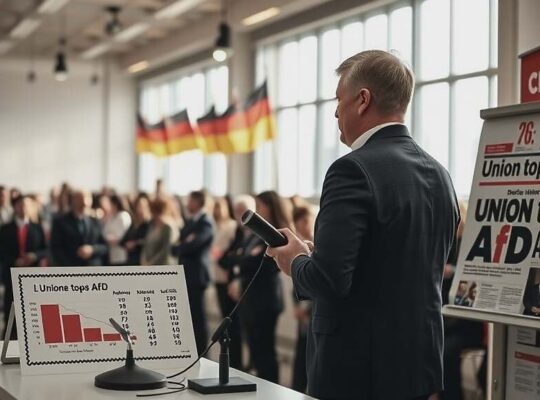
The Christian Democratic Union (CDU) in Saxony-Anhalt is intensifying its campaign against the Alternative for Germany (AfD), with leading candidate Sven Schulze dismissing the party’s policy proposals as “zero” and expressing confidence in the CDU’s ability to secure a majority in the upcoming state election. Schulze, currently serving as Minister for Economics and a member of the CDU’s federal executive, launched a scathing critique of the AfD’s platform in an interview with “Stern” magazine.
He directly challenged the AfD’s central claim that Germany would be free from its “worries” without migrants, labeling it a “lie” and accusing the party of simplistic rhetoric concerning complex issues. Schulze framed the September 6th election not as a referendum on the national government, but as a crucial test of Saxony-Anhalt’s ability to maintain a functional government. He warned that an AfD-influenced legislature would lead to “chaos” due to the party’s perceived lack of substantive policy proposals.
Highlighting what he described as the AfD’s “inability” Schulze pointed to the party’s recent rejection of federal funding earmarked for infrastructure projects-a sum of 2.6 billion euros destined for Saxony-Anhalt. “I will not allow my state to become an experiment” he stated, suggesting the AfD’s opposition stemmed from ideological rigidity rather than genuine concern for the region’s welfare. He further characterized the party as an “empty shell” driven by the individual agenda of its top candidate, Ulrich Siegmund, effectively minimizing its organizational depth.
Schulze emphatically ruled out any potential coalition governments with either the AfD or the Left party, categorically rejecting the prospect of their inclusion in his cabinet. While current polling data places the AfD significantly ahead with approximately 40% support, leaving the CDU trailing behind, Schulze remains optimistic, asserting that a CDU majority is within reach and a politically stable government for Saxony-Anhalt is essential. This ambition, however, is tempered by the reality that Schulze may require the support of the Left party to become Minister-President based on current projections. The upcoming election presents a critical juncture for Saxony-Anhalt, with the potential to significantly reshape the state’s political landscape and its relationship with the federal government.