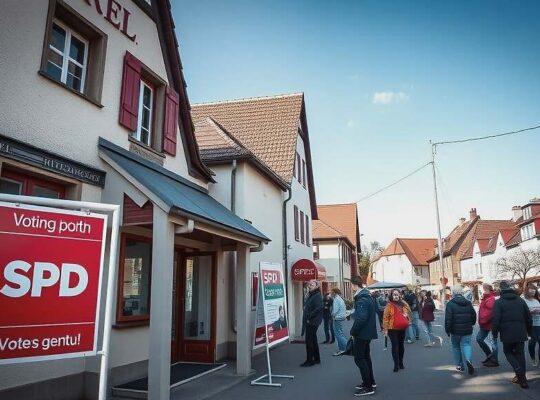
A week before the state election in Rhineland‑Palatinate, the CDU is just ahead of the SPD in a new ZDF “Politbarometer” poll, according to the new survey results. However, when respondents were asked which candidate they would prefer as Ministerpräsident, SPD’s Alexander Schweitzer is by a wide margin ahead of the CDU and AfD contenders.
The poll, if it were an election day, would give the following shares: SPD 26 %, CDU 28 %, Greens 9 %, AfD 19 %, Free Voters 5 %, Left 5 %. The remaining parties together would score 8 %. Twenty‑five percent of the respondents were undecided on whom or whether they would vote, and another 30 % did not yet have a firm preference.
With these figures, a coalition of CDU and SPD would be enough to form a government. Possible coalitions that would include the AfD were ruled out by the other parties themselves.
In the last state election, five years ago, the results were: SPD 35.7 %, CDU 27.7 %, Greens 9.3 %, AfD 8.3 %, FDP 5.5 %, Free Voters 5.4 %, Left 2.5 %. All other parties collectively had 5.6 %.
The evaluation of the governing parties is fairly critical. On a scale from +5 to -5 the SPD’s performance in the state government received an average of 0.3. The Greens and the FDP were seen even more negatively, with averages of -0.8 each. Opposition parties received mixed reviews: the CDU scored 0.1, the Free Voters -0.1 and the AfD a very poor -2.6.
When asked who would be the best choice as Ministerpräsident, 41 % of respondents preferred Alexander Schweitzer. Only 23 % favored CDU’s candidate Gordon Schnieder, and a mere 6 % backed AfD’s Jan Bollinger. On the same +5 to -5 scale, Schweitzer was rated an average of 2.0, Schnieder 1.1 and Bollinger -2.3.
None of the proposed coalition formats achieved more approval than rejection. The least negative option was a CDU‑SPD coalition led by the CDU: 36 % said it was good, 45 % bad, 16 % neutral. The next most favourably viewed was a SPD‑CDU coalition led by the SPD: 35 % good, 48 % bad, 14 % indifferent. A CDU‑AfD coalition was largely rejected, with only 17 % positive, 74 % negative, and 6 % neutral.
The public’s priority issues differ from those at the federal level and from the agenda highlighted in Baden‑Württemberg in recent years. The top concern is education/school, cited by 25 % of respondents as the current problem in the state. Infrastructure follows with 20 %. Economic conditions are next at 15 %, then prices and costs at 14 %, transport at 13 %, and climate/energy at 11 %.
In the education/school category, the CDU has shown a greater willingness to lead than the SPD compared with 2021, with the former having the highest competence at 27 % versus the SPD’s 24 %. For the economy, the CDU now leads the SPD with 24 % compared to 19 %. Still, many respondents are unsure which party could best solve economic challenges.
The survey was carried out by the Mannheim Research Group Wahlen. Interviews were conducted by phone and online from 10 to 12 March among 1,121 eligible voters in Rhineland‑Palatinate.