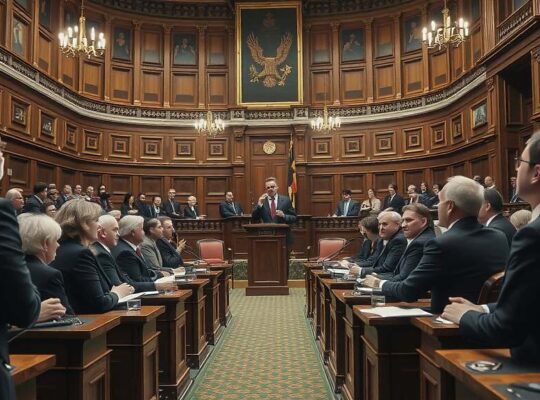
The Social Democratic Party (SPD) has cautiously rebuffed a proposal from the Christian Democratic Union (CDU) for a revision of their existing coalition agreement, emphasizing the ongoing validity of the established framework. The suggestion, spearheaded by CDU parliamentary affairs director Steffen Bilger, calls for a “Coalition Agreement 2.0” to guide the government’s work during the second half of the legislative period.
Bilger’s initiative stems from a perceived need for a refreshed foundation for policy decisions, particularly given the rapidly evolving geopolitical landscape. He argued that unforeseen events in recent years-including the influx of Syrian refugees, the COVID-19 pandemic and Russia’s invasion of Ukraine-highlighted the imperative for governmental adaptability and a willingness to reassess priorities.
SPD parliamentary affairs director Dirk Wiese, while acknowledging the validity of Bilger’s points regarding the necessity of situational responsiveness in government, countered that the current coalition agreement remains robust and essential for long-term national goals. He pointed to the substantial commitments already embedded within the existing framework and anticipated outcomes from ongoing commissions tasked with reforming social security systems, which are scheduled to report in 2026.
However, Wiese’s measured response and insistence on the existing agreement’s value are drawing criticism. Some political analysts argue that the SPD’s reticence signals a reluctance to address growing policy divergence with the CDU, potentially hindering effective governance as the coalition navigates increasingly complex challenges. The suggestion of an update has been interpreted by some as a potential lifeline for the CDU, allowing them to subtly shift the policy agenda without formally dismantling the existing accord.
The debate underscores the inherent tensions within the coalition government, balancing the need for continuity with the demand for flexibility in an era defined by rapid and unpredictable crises. Whether the CDU’s push for a revised agreement will gain further traction remains to be seen, but the discussion has ignited a critical examination of the coalition’s ability to adapt and maintain unity in the face of mounting pressures.