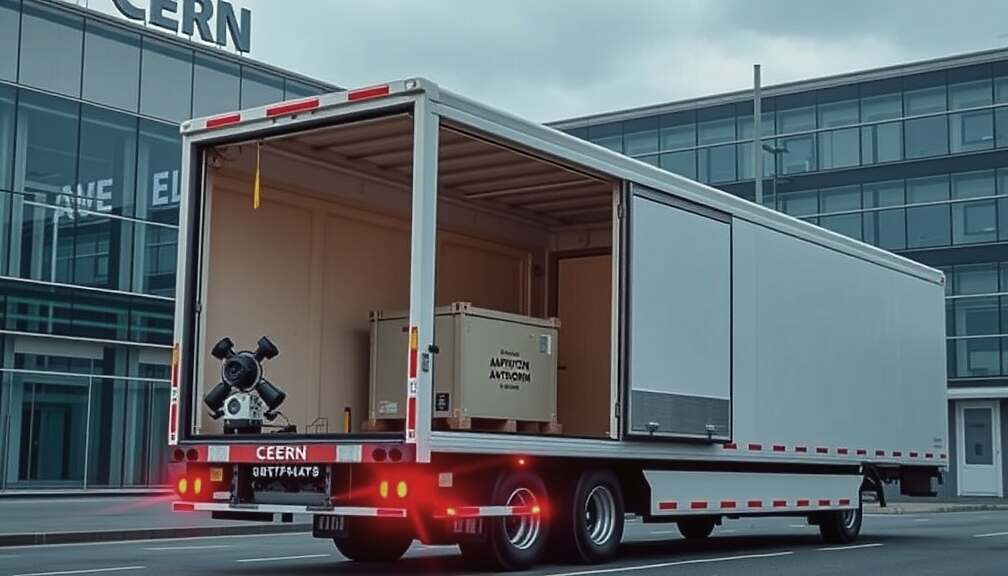
On Tuesday, the European nuclear research centre CERN in Geneva transported antiprotons for the first time on a truck, a development announced by the University of Düsseldorf’s Heinrich‑Heine University. Stefan Ulmer, the leader of CERN’s BASE experiment, provided the details.
Storing antiprotons over long periods is challenging because antimatter annihilates immediately upon contact with ordinary matter. Ulmer explained that the antiprotons must be confined using electric and magnetic fields inside an environment of extremely high vacuum so they never touch air molecules or the containment vessel.
The antiprotons were produced at CERN’s “Antimatter Factory” the only facility in the world capable of delivering these particles at very low energy. The BASE team collected a cloud of roughly one hundred antiprotons inside an 850‑kilogram cage that uses magnetic and electric fields to trap the particles. After detaching the cage from the stationary experiment station, the scientists loaded it onto a truck, drove it across the CERN campus, and reconnected it to the experiment apparatus.
This truck‑based transport marks an initial step toward delivering antimatter to other European laboratories, where measurements could be made in environments with reduced background interference.