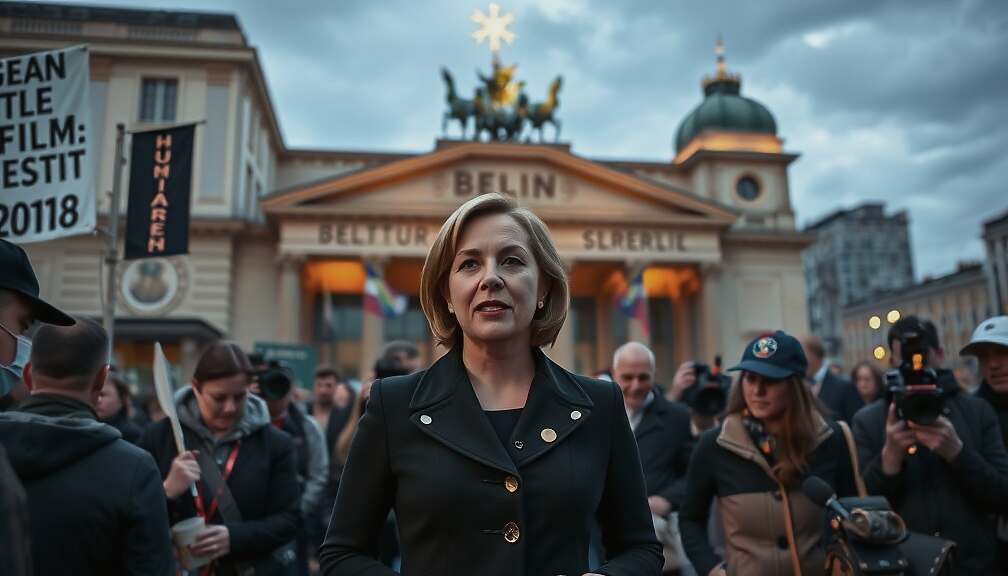
Former German Culture Minister Claudia Roth (Greens) sharply criticized the approach of her successor, independent politician Wolfgang Weimer, toward the Berlinale. “Politics should never influence the artistic content of culture, it should not decide what hangs in museums or which films are shown” Roth told the “Tagesspiegel” (Friday edition). “The autonomy of cultural institutions must remain protected”.
Weimer had called an extraordinary meeting of the board of the company “Kulturveranstaltungen des Bundes in Berlin GmbH” (KBB) for Thursday morning. In that meeting, a discussion about the orientation of the Berlinale would take place, confirmed the BKM (Federal Office for Culture and Media). The talks were said to continue in the coming days. Earlier reports had indicated that the April 2024‑appointed head of the Berlinale, Tricia Tuttle, was to be replaced. The backdrop was the screening of Syrian‑Palestinian director Abdallah Alkhatib at the festival’s awards ceremony on Saturday.
Roth, who served as Culture Minister from 2021 to 2025, said that in a world where authoritarian states are rising and democracy is increasingly under attack, artistic freedom is under pressure. She added that Article 5 of Germany’s Basic Law-freedom of expression, arts, culture, and science-constitutes a pillar of democracy. This does not mean agreeing with all artistic viewpoints, she clarified, but that politics must defend the freedom of art even when it disagrees. “That freedom is especially important in today’s political climate” she said.
Roth accused the AfD of directly targeting culture in regions where it holds majorities, sabotaging festivals and turning institutions into “cultural prisons”. She warned that it must not appear that German politics can influence the content of the country’s most important film festival. “Autonomy, independence and space-within the bounds of the law-are essential” she said.
She warned that abandoning these principles would be a defeat against nations where politics controls art, citing the United States and former President Trump’s influence over what museums display, how the Kennedy Center operates and what books are allowed or banned. “I am not saying this applies to anyone in particular, but we must protect Article 5 and not attack it” Roth added.
Katrin Göring‑Eckardt, spokesperson for culture and media of the Greens’ Bundestag faction, also blasted Weimer. “The federal government has no ideas or concept to fight antisemitism” she told the newspaper. Even if staff‑related matters have been postponed, the damage is done and Weimer again creates uncertainty in an entire industry. She said art and culture must remain free from state interference.
Göring‑Eckardt criticized Weimer’s handling of the festival and its organizers, saying the debate over Weimer’s potential dismissal of the festival’s creative director is emblematic of his political strategy in fighting antisemitism. “Weimer is retreating and avoiding responsibility” she said.
The SPD condemned Weimer’s actions as excessive. Martin Rabanus, the party’s cultural‑policy spokesman in the Bundestag, told the “Tagesspiegel” that inviting the world into Germany means accepting that artists bring their personal views. “If we can’t do that, we don’t open spaces but close them” he said.
The Left party called the engagement with the Berlinale a grave mistake. National chair Ines Schwerdtner warned that a culture minister who has normally opposed “cancel culture” now intervenes politically in an international film festival, sending a dangerous signal for artistic freedom. “This risks massive damage to the Berlinale’s reputation” she said. “If Tuttle must step down because of Palestine solidarity, that would signal the end of the Berlinale”.