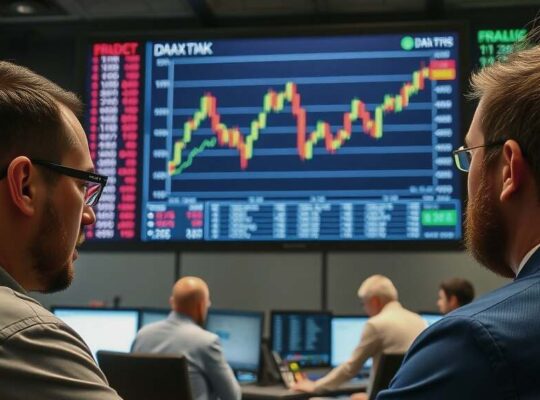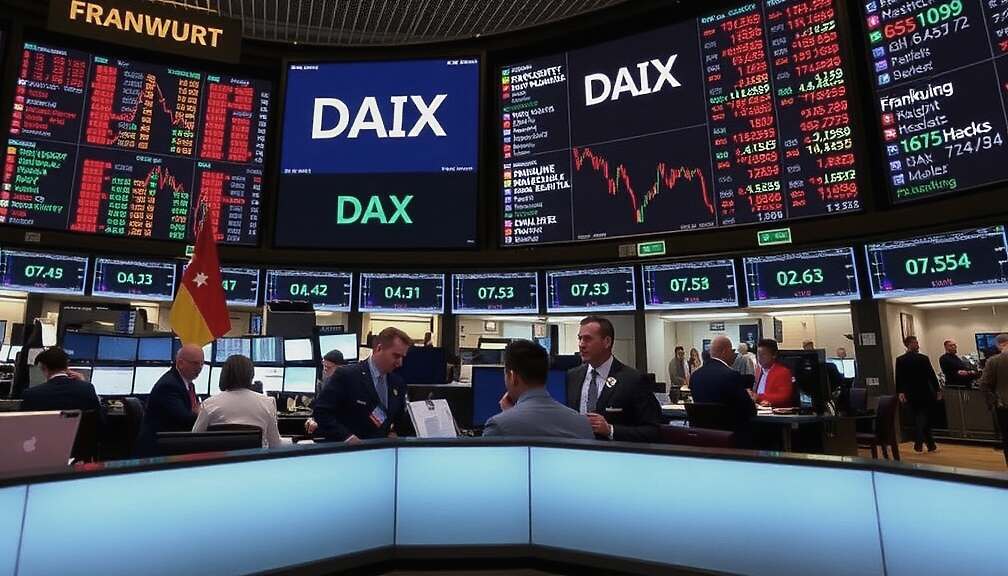
The German DAX opened slowly on Friday morning. At about 9:30 a.m. local time the benchmark index was at 25,305 points, which is roughly 0.1 % above the previous day’s closing level.
Asia saw investors walking away with profits from well‑performing stocks, especially in the technology sector. CMC Markets’ chief market analyst, Andreas Lipkow, pointed out that the Chinese market was an exception because the positive impact of the new tariffs was still felt there. Chinese companies now face an average tariff of only 15.6 %, which helps the export‑driven Chinese economy.
Despite many disruptive factors-including ongoing tensions between Iran and the United States-the DAX delivered a solid 3.3 % gain for February. While other European indices recorded new record highs, Germany’s heavy reliance on exports has limited the strength of its market gains.
Pre‑market activity was dominated by BASF’s earnings figures. The chemical giant’s performance is again being dampened by the comparatively weak economic outlook in the Eurozone. BASF is expected to see its annual profit stagnate at last year’s level, and the lack of profit momentum has pushed the shares into the loss zone ahead of the market opening.
Investors will be looking mainly at key data releases later in the day. German consumer price inflation data and U.S. producer price indices are scheduled for release in the afternoon, followed by the Chicago Purchasing Managers’ Index at 4 p.m. Eastern Time.
Currency movements: the euro strengthened slightly compared with the dollar. One euro equalled 1.1816 USD, while one U.S. dollar was worth 0.8463 EUR.
Gold prices slipped marginally in the morning; a fine ounce fetched $5,177, down 0.1 %. This corresponds to 140.85 EUR per gram.
Oil saw a modest uptick: Brent crude was trading at $71.17 per barrel at 9 a.m. German time, up 42 cents or 0.6 % from the previous day’s close.