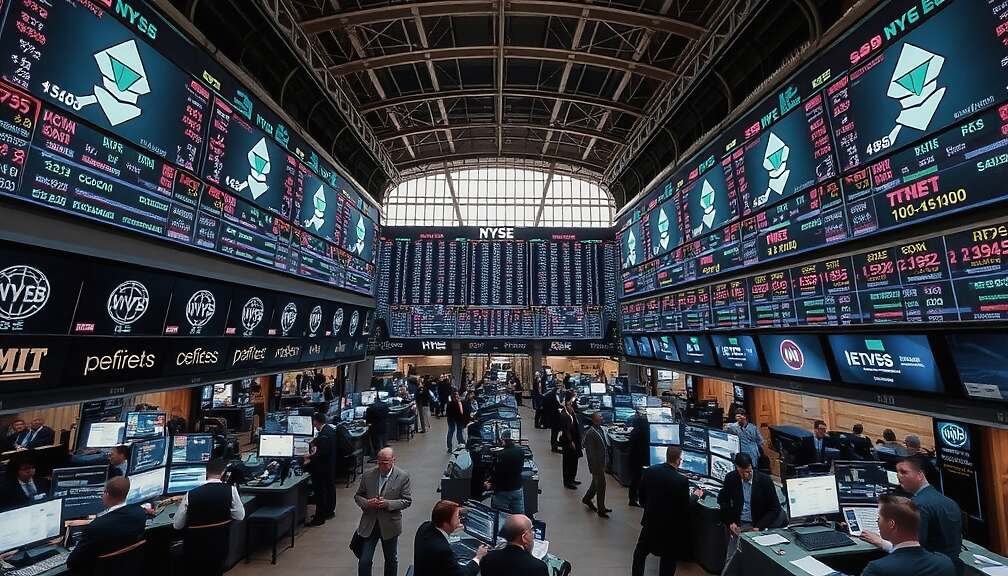
German equities surged at the start of the week, fueled by geopolitical anxieties and a reassessment of investment strategies. The DAX index closed at 25,405 points, marking a 0.6% increase and extending a positive trend that has already seen the index reach a record high for the fifth time in just seven trading days this year. This performance demonstrates a significant shift in investor confidence, distancing the German market from Wall Street’s relative stagnation.
The gains were particularly pronounced for healthcare giant Fresenius Medical Care, its parent company Fresenius and consumer goods firm Beiersdorf. Conversely, automotive stocks faced headwinds, with BMW, Volkswagen, Porsche Holding and Mercedes-Benz all experiencing declines. This divergence signals a potential recalibration within the German industrial sector, suggesting investor concerns may be focused on the specific challenges facing the auto industry.
The market rally is being attributed, in part, to anxieties surrounding former U.S. President Donald Trump’s recent rhetoric questioning the independence of the Federal Reserve. This uncertainty has spurred a flight to safety, driving up the price of gold – which reached $4,622 per fine ounce, a 2.5% increase – and surprisingly bolstering the German stock market. “Trump’s actions are pushing investors towards safe havens like gold, but also into the German stock market” explained Christine Romar, Head of Europe at CMC Markets, adding that this provides fertile ground for continued upward momentum.
The failure of anticipated profit-taking at the 25,000-point mark further reinforces the bullish sentiment. Many had predicted a correction at this psychological threshold, but the sustained buying pressure has forced those betting on such a downturn back into the market. Notably, Romar highlighted an increasing trend of international investors pulling capital from the U.S. and actively seeking alternative investment options, with Germany increasingly becoming a favored destination.
The euro strengthened against the dollar, trading at $1.1678, reflecting broader currency market dynamics. Brent crude oil also saw a rise, reaching $63.56 per barrel, indicating a subtle uptick in energy prices, though perhaps less significant than the broader equity market enthusiasm.
The DAX’s rapid ascent and shifting investment flows raise critical questions about the long-term sustainability of this rally. While current geopolitical uncertainty provides a short-term catalyst, the underlying fundamentals of the German economy and the broader European landscape will ultimately determine whether this bullish trend can be maintained. The automotive sector’s underperformance, alongside the appeal of German equities as a safe haven, warrants careful observation in the coming weeks.