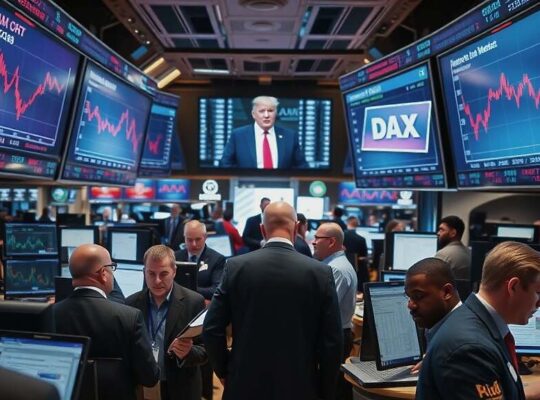
The German DAX index registered a gain on Thursday, closing at 24,295 points – a 0.7 percent increase compared to the previous day’s close. This movement reflects a complex interplay of investor sentiment driven by the Federal Reserve’s policy decisions and anxieties surrounding the valuations of technology companies.
Christine Romar, Head of Europe at CMC Markets, characterized the day’s trading as marked by a tug-of-war. “Investors were pulled between the preemptive holiday gift from the Federal Reserve and the disappointing results from software giant Oracle” she explained. The Federal Reserve’s decision to lower interest rates and initiate an asset purchase program initially fueled optimism, but Oracle’s subsequent earnings report and cautious outlook swiftly reintroduced concerns about a potential bursting of the AI bubble. Oracle’s stock plummeted 13 percent in after-hours trading, dragging down futures contracts despite a previously bullish market.
Romar emphasized that the underlying issue isn’t necessarily a decline in Oracle’s core business, but rather market apprehension about inflated valuations. “Examining Oracle’s financial data reveals how much the market fears overpaying for future growth prospects without near-term returns” she stated. While Oracle’s order books remain healthy and its cloud business continues to expand, albeit at a slightly slower pace than initially anticipated, the appetite for taking on further debt to finance future earnings has diminished. Investors are increasingly reluctant to absorb the associated risks.
The DAX’s resilience and its preference for a northward trajectory, appears to stem, in part, from the relative absence of dominant AI-focused stocks and the continued strength of more traditional industrial sectors. This contrasts with the performance of major US technology companies, which negatively impacted Wall Street indices.
Throughout the trading day, Brenntag, Daimler Truck and Heidelberg Materials led the gains on the Frankfurt Stock Exchange, while MTU, Deutsche Börse and Eon lagged behind.
Elsewhere, the price of Brent crude oil experienced a significant decline, falling to $60.92 per barrel – a drop of 129 cents, or 2.1 percent, compared to the previous day’s close. The Euro strengthened to $1.1749, with one dollar costing 0.8511 euros. The volatility underscores the fragility of current market confidence and the persistent geopolitical and economic factors contributing to fluctuations.