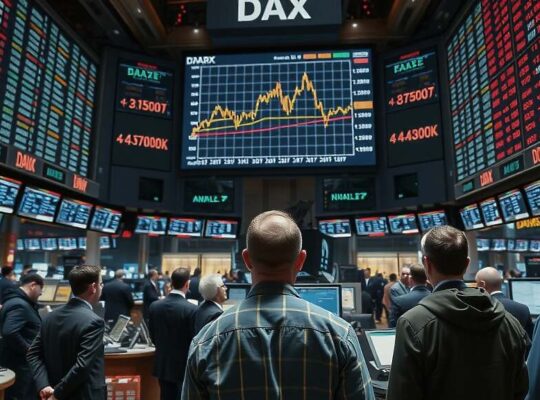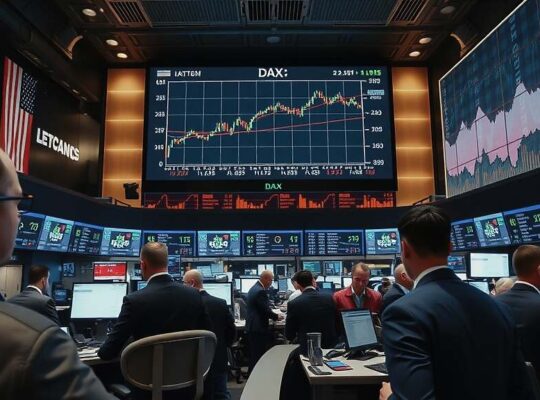
The DAX began Monday’s trading session in decline. By about 9:30 a.m. the benchmark index was around 22,235 points, 0.3 % below Friday’s closing level. The strongest performers were SAP, RWE and Deutsche Telekom, while Zalando, Airbus and Continental trailed at the bottom of the list.
Chief market analyst Jochen Stanzl of Consorsbank noted that stocks have already priced in a short‑term Middle‑East conflict for the past four weeks. With the Houthi militants’ recent escalation and the growing likelihood of U.S. ground forces entering the fight, investors now face the risk of an extended war. The sharp fall on Friday, he added, signals a surrender of optimistic sentiment, and market participants are awaiting confirmation from Iran that talks with the United States are indeed underway.
Stanzl said the markets have settled on a scenario where a Brent price of about $100 would drive a mild slowdown in growth. However, the market has not yet factored in a significant downward revision of growth and inflation forecasts-the same risk that emerged on “Liberation Day”. That risk would materialise if oil prices sustainably rose above $120. Historically, such conditions tend to trigger equity market pullbacks of 15-20 %.
A prolonged disruption in the Strait of Hormuz with Brent hovering near $120 would not, on its own, trigger a recession. But if oil prices remain in the $100-120 range for several months, coupled with fiscal easing for consumers, the outlook could shift toward stagflation. Higher inflation would likely push central banks toward rate hikes, a scenario reminiscent of 2022 and a potential drag on equities.
The picture changes with a sharp, sudden price spike. “If oil jumps well above $150, a recession becomes probable. Rate hikes would then be a secondary concern; instead, a demand slump would put pressure back on oil prices” Stanzl warned. “For markets, it’s not just the peak level but how long the shock lasts”. Conversely, if tensions deescalate quickly and oil traffic through the Strait of Hormuz resumes, the initial market reaction is expected to be positive.
The euro was largely unchanged in the early session. One euro traded at $1.1502, and one dollar was worth €0.8694.
Oil prices had risen sharply by mid‑morning: North Sea Brent barrels were trading at $115.80 per barrel around 9 a.m. German time, an increase of 2.9 % from the previous day’s close.