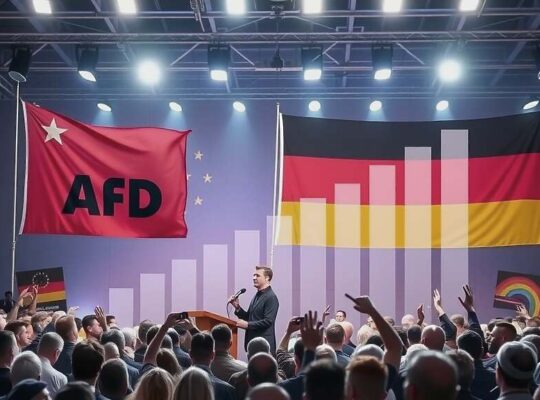
The newly appointed co-leader of the Basisvorwärts (BSW) party, Fabio De Masi, has categorically ruled out a formal coalition agreement with the Alternative für Deutschland (AfD), a move intended to navigate the complexities of the German political landscape following the departure of founding figurehead Sahra Wagenknecht. In an interview with the Tagesspiegel, De Masi emphasized that while outright coalition formation is off the table, BSW remains open to pragmatic cooperation on a case-by-case basis, potentially including the election of AfD members to parliamentary committee positions and the support of AfD-sponsored proposals.
This nuanced approach signals a calculated strategy to position BSW as a potential kingmaker in future parliamentary configurations, particularly in anticipation of the 2026 state elections. De Masi explicitly rejected both broad, all-encompassing coalitions designed to solely counter the AfD and narrowly focused “anti-AfD” alliances, arguing that both fail to address the underlying discontent driving voter frustration. He floated the possibility of “expert governments” relying on shifting majorities, suggesting a future where alliances are formed on individual policy objectives rather than rigid ideological lines.
The shift in leadership, with De Masi and Amira Mohamed Ali succeeding Wagenknecht, who now leads the party’s foundational values commission, marks a turning point for BSW. De Masi underscored a need to modernize internal party structures and empower its growing membership, many of whom are new to the political process. He challenged the perception of BSW primarily existing through media appearances, stating that the party’s direction cannot be dictated solely by external narratives.
Critics argue that BSW’s willingness to engage with the AfD, even in a limited capacity, risks normalizing the far-right party and potentially legitimizing its increasingly nationalistic rhetoric. The decision to consider supporting AfD proposals, coupled with the insistence on rejecting strict ideological barriers within parliamentary committees, raises questions about BSW’s long-term political trajectory and whether it can effectively distance itself from the AfD’s core values while appealing to a broader electorate grappling with economic insecurity and political disillusionment. The ability of De Masi to unify the party around this more pragmatic, albeit potentially controversial, roadmap remains to be seen.