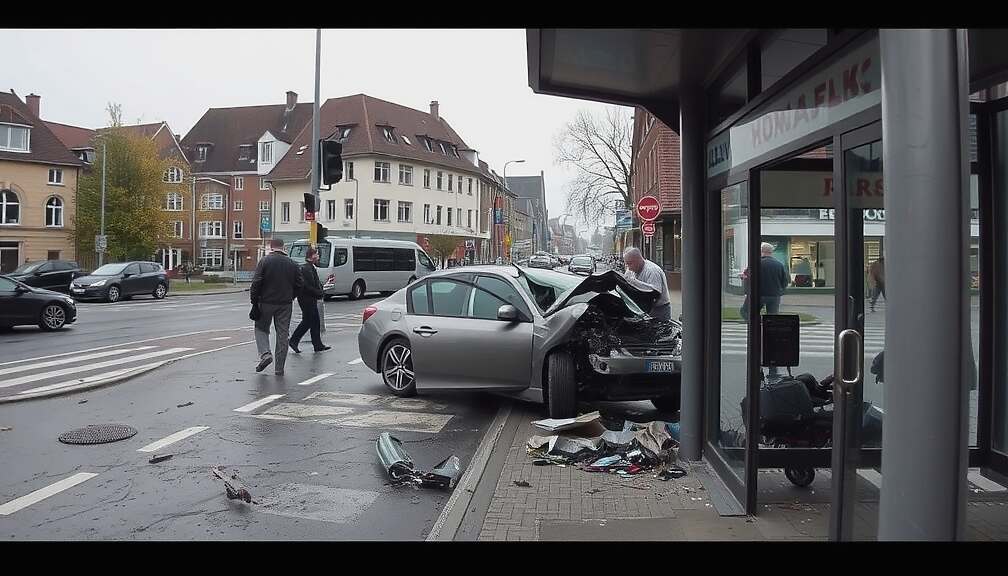
The state prosecution in Hesse is investigating a 32-year-old man on suspicion of attempted murder following a vehicular attack in Giessen on Monday that left one woman seriously injured and two others with minor injuries. While initial reports sparked anxieties about a politically motivated or terrorist act, authorities have confirmed that no such indications have emerged during preliminary investigations.
The suspect, an Azerbaijani national residing in Giessen with no prior criminal record, reportedly drove onto the opposing lane before colliding with a parked vehicle. The force of the impact propelled the vehicle into a bus stop, striking a 64-year-old pedestrian and inflicting severe injuries. The suspect’s erratic behavior continued; he allegedly proceeded with his journey, partially using a pedestrian walkway and further injured two individuals before ultimately colliding with another parked car. He was apprehended by a 29-year-old local resident until police arrived, having already collided with multiple vehicles prior to the initial lane change, resulting in minor injuries to two occupants.
The investigation remains ongoing, with prosecutors emphasizing a lack of clarity regarding the suspect’s motives. Shortly after his arrest, he reportedly made “unrelated statements” hindering investigators’ ability to establish a clear sequence of events or underlying rationale. Critically, given observations surrounding his demeanor, the prosecution has commissioned a psychiatric evaluation to assess potential indicators of acute psychosis and a mental health condition. Furthermore, a forensic accident reconstruction expert has been brought in to analyze the sequence of events.
The incident raises serious questions about public safety and the potential for individuals experiencing acute mental health crises to pose a threat. While authorities have ruled out a politically motivated attack, the severity of the incident and the suspect’s subsequent behavior underscore the need for enhanced mental health support and early intervention programs within the community. The legal process will now center on determining the suspect’s mental state at the time of the incident and whether it significantly impaired his actions, a factor that could influence potential charges and sentencing.