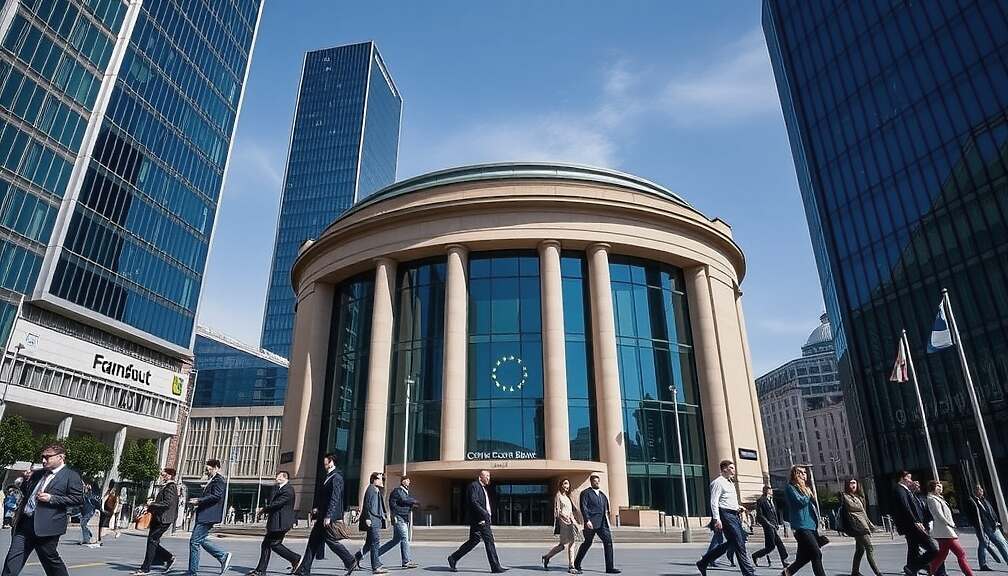
The European Central Bank (ECB) announced on Thursday that it had extended the pause on interest‑rate hikes and kept its key policy rate unchanged at 2.0 %. This decision was made at the ECB’s Governing Council meeting in Frankfurt. The deposit facility rate therefore remains at 2.00 %, the main refinancing operations at 2.15 %, and the marginal lending facility at 2.40 %.
The Governing Council reaffirmed its commitment to bring inflation close to its 2 % medium‑term target. It warned that the war in the Middle East has introduced considerably more uncertainty, creating upward pressure on inflation and downward pressure on economic growth. Short‑term inflation will be heavily impacted by higher energy prices driven by the conflict. The medium‑term effects will depend on the conflict’s intensity and duration, as well as on how much of the energy price rise passes through to consumer prices and the wider economy.
According to the ECB, the institution is well positioned to manage this uncertainty. Inflation is near the 2 % target, long‑term inflation expectations are firmly anchored, and the economy has shown resilience in recent quarters. New data coming in the near future will help assess the war’s impact on inflation expectations and associated risks. The ECB is monitoring developments closely and will use a data‑driven approach to set monetary policy.
The latest projections, prepared by ECB economists, now extend through 11 March, a later cut‑off than usual. In the baseline scenario, total inflation is expected to average 2.6 % in 2026, 2.0 % in 2027, and 2.1 % in 2028-an upward revision from the December forecasts, driven largely by higher energy prices due to the conflict. Inflation excluding energy and food is projected at 2.3 % in 2026, 2.2 % in 2027, and 2.1 % in 2028, also higher than the December outlook because the elevated energy costs lift even the core inflation rate.
Growth expectations are moderated somewhat, with real GDP growth projected at 0.9 % in 2026, 1.3 % in 2027, and 1.4 % in 2028. The lower growth outlook for 2026 reflects global impacts on commodity markets, real incomes, and confidence stemming from the war. Nonetheless, low unemployment, strong private‑sector balance sheets, and public spending on defense and infrastructure are expected to continue supporting growth.