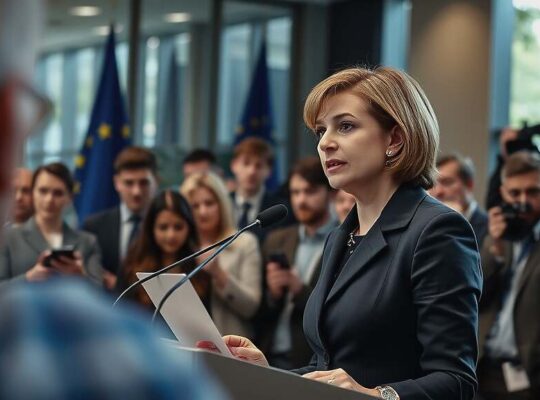
The European Union is intensifying efforts to formally integrate the Western Balkan nations, signaling a shift away from the protracted accession processes of the past. Antonio Costa, President of the EU Council, emphatically reaffirmed the bloc’s commitment to the region’s future within the Union, concluding a recent EU-Western Balkans summit in Brussels.
The current pace of expansion represents a marked acceleration compared to the stagnation observed over the last fifteen years. Montenegro’s path toward membership has notably quickened, with five accession chapters successfully closed just this week. Albania has also managed to rapidly open all negotiation groups, a feat achieved as recently as November, raising expectations for further expedited reforms in the coming year.
While acknowledging the progress, analysts remain cautious. The commitment to North Macedonia focuses on strengthening regional interconnectivity, though tangible advancements are not anticipated until 2026. Costa’s statement, while positive, underscored the understanding that Skopje’s authorities are now fully aware of the necessary steps to fulfill accession criteria, implying a degree of ongoing scrutiny.
Bosnia and Herzegovina’s adoption of a reform agenda this year is viewed as a critical step, allowing the nation to fully leverage EU support and benefit from a phased integration process. However, the complex political landscape within Bosnia and Herzegovina continues to present significant implementation challenges.
For Kosovo, the focus remains on fostering inter-communal trust, with the upcoming parliamentary elections identified as a potential “decisive moment” to solidify reforms and constructively engage in the accession process. Observers highlight the fragility of the situation and the importance of ensuring a fair and inclusive electoral environment.
Costa’s concluding remarks emphasized that overcoming historical divisions remains paramount for the Western Balkan states to fully embrace their prospective roles as EU members and contribute to a stable, prosperous and unified Europe. He tempered optimism with a stark acknowledgment of the hurdles that lie ahead, implicitly cautioning that the path to integration remains arduous and dependent on sustained political will and demonstrable progress in structural reforms. The EU’s renewed push represents not merely a gesture of goodwill but a strategic imperative to counter external influence and bolster regional stability, albeit one fraught with considerable political and economic complexities.