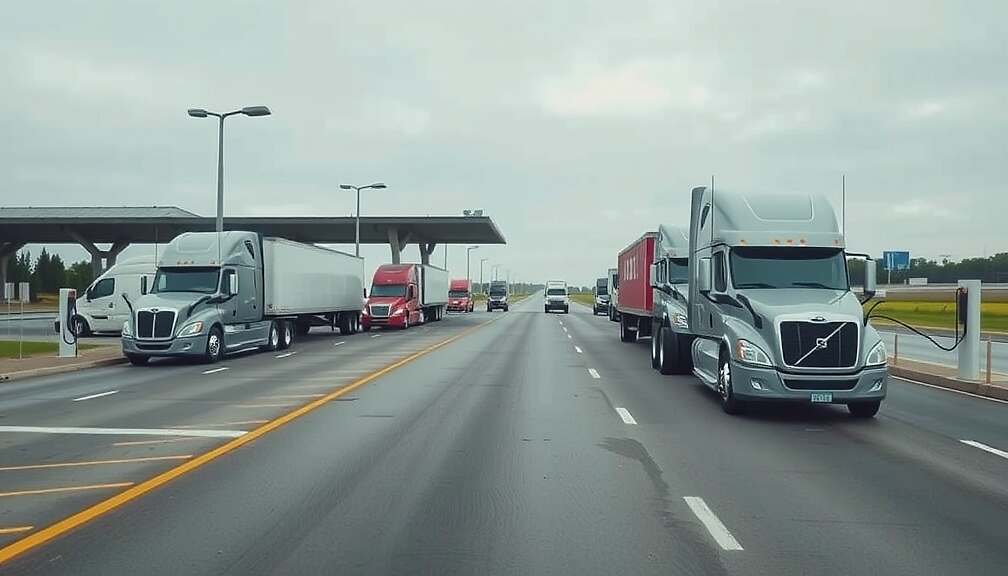
The European Commission has authorized a substantial €1.6 billion in state aid for Germany to develop a rapid charging infrastructure for electric trucks at Autobahn rest stops, marking a significant, albeit potentially politically fraught, step towards decarbonizing the nation’s heavy goods transport sector. The German Federal Ministry of Transport confirmed the approval on Thursday, signaling a concrete advancement on long-stalled plans for a nationwide network.
The authorization permits the construction of public rapid charging points for battery-electric trucks on federal land, primarily focusing initially on Autobahn rest areas that are not commercially operated. While lauded by Transport Minister Patrick Schnieder (CDU) as providing “a reliable entry into public charging for heavy electric trucks” and guaranteeing “planning security and tempo” the decision also exposes underlying complexities and concerns about the speed and equitable distribution of the transition.
Critics argue the focus on unmanaged rest areas, while expedient for bureaucratic expediency and avoiding immediate commercial disruption, may not represent the most effective or strategically advantageous placement for a truly comprehensive charging network. The reliance on federal land also bypasses potential revenue streams and entrepreneurial investment that could accelerate the rollout.
Furthermore, the decision’s immediate political context is noteworthy. The CDU’s rationale for prioritizing federal land demonstrates a deliberate avoidance of engaging with private sector investment, raising questions about long-term sustainability and potential dependency on state funding. While proponents highlight the need for a “reliable start” some industry observers suggest a more collaborative approach, combining public investment with private enterprise, might have yielded a more robust and flexible infrastructure solution.
The implementation, spearheaded by the Autobahn GmbH des Bundes and the Nationale Leitstelle Ladeinfrastruktur under the NOW GmbH framework, underscores the government’s intent to directly control the initial phase of this crucial infrastructural build-out. While expansion to commercially operated rest areas is anticipated in the future, the narrow focus now invites scrutiny on whether this top-down approach will sufficiently address the evolving needs of the logistics sector and the broader decarbonization goals. The long-term success hinges not only on the technical feasibility of deploying the charging infrastructure but also on navigating the intricate political and commercial landscape surrounding the transition to electric heavy goods transport.