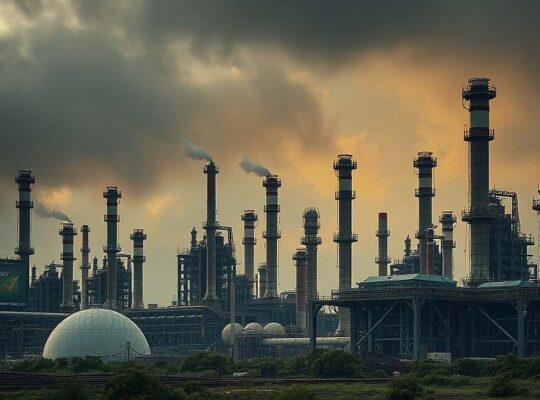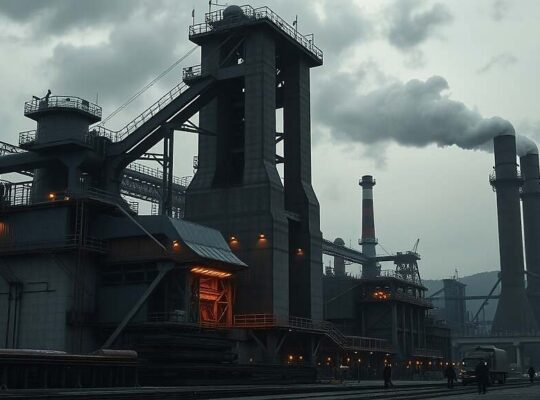
The EU Commission plans a significant overhaul of the Emissions Trading System (ETS) for industrial and energy sectors, which would permit considerably higher greenhouse gas emissions in the short term. This reform is projected to result in CO2 emissions from these sectors being approximately 30 percent higher by 2040 than if the current emissions reduction path were maintained. Furthermore, the integration of CO2 storage into the emissions trading system is set to offer affected companies more operational flexibility.
Under the existing European ETS (ETS-1), businesses must purchase certificates for every tonne of CO2 equivalent emitted, typically resulting from burning coal, oil, and gas. The total number of certificates decreases annually, establishing a fixed ceiling for CO2 emissions in industry and energy. When companies reduce their emissions slower than the supply of certificates declines, the price of these certificates rises. This mechanism is designed to provide a price advantage to climate-friendly production over polluting methods.
The Commission now intends to slow down the annual reduction rate of certificates significantly. Currently, the reduction rate stands at 4.3 percent, slated to rise to 4.4 percent in 2028. However, the new proposal suggests this reduction will slow to 3.7 percent by 2031 and further decline to just 1.7 percent by 2036.
While companies were previously granted free CO2 certificates, the free allocation was partially phased out as part of the EU’s “Fit for 55” climate package, which aimed to steer the EU from a path of over four degrees of warming toward limiting climate change to just over two degrees Celsius. The introduction of the Carbon Border Adjustment Mechanism (CBAM)-a form of tariff on CO2-intensive imports-was implemented to counteract competitive disadvantages.
The new Commission proposal suggests continuing this free allocation to companies beyond 2030. Critically, receiving these free certificates will depend on the companies reinvesting the corresponding funds into decarbonization efforts.
Teresa Ribera, Executive Vice-President of the European Commission, stated that emissions trading systems ensure that pollution pays a price while simultaneously generating revenue necessary for investments in the future. Since revenue from certificate auctioning flows into the German Climate and Transformation Fund (KTF) to support climate-friendly technology switchovers, a larger proportion of free certificates would reduce these crucial funds.
Looking ahead, the ETS is slated to be expanded to cover international flights within a 5,000-kilometer radius, including private jets.
This emissions trading reform will be complemented by a reduced reliance on fossil fuels, an electrification action plan, and a law governing “future-proof energy bills.” EU Energy Commissioner Dan Jorgensen remarked that “we must replace black, expensive, and harmful molecules with cheap, clean electrons.”
The proposal also sets an electrification target of 46 percent by 2040, effectively doubling the current level. To support this transition, taxes on electricity will be set lower than those on gas, and grid fees will be optimized for efficiency. Furthermore, the adoption of smart meters and intelligent metering technology is expected to increase significantly.